In the construction of accurate and reliable AI models for radiology, medical image annotation is crucial. Annotated datasets form the foundation of numerous crucial and contemporary AI solutions in the healthcare sector, such as tumor detection or fracture identification.
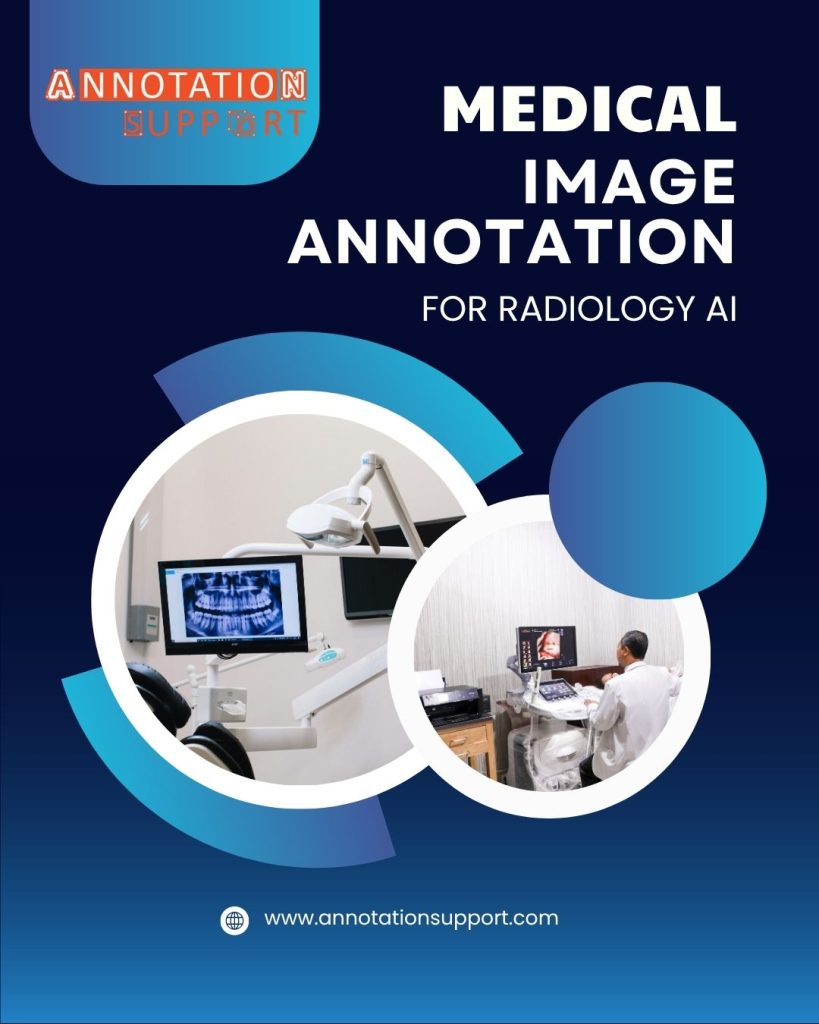
What is Medical image annotation?
Medical image annotation involves marking, labeling, or naming the medical images including ultra sounds, MRIs, CT scans and X-rays for training AI and machine learning models. These annotations aid in pattern recognition, the identification of abnormalities and may assist radiologists with diagnosis, which may benefit algorithms.
Why is Annotation Important in Radiology AI?
The data quality and annotations play a crucial role in the development of Radiology AI. AI models are unable to learn properly without accurate labelling.
Key benefits include:
- Improved diagnostic accuracy
- Faster image analysis
- Early disease detection
- Decreased workload for radiologists
- Enhanced patient outcomes
Methods of medical imaging employed:
There are a number of different imaging modalities that are used with radiology AI, such as:
- CT scans – Damage to lungs, heart, and other organs
- Tumors, internal injuries – CT Scans (Computed Tomography)
- MRI (Magnetic Resonance Imaging) – Soft tissue analysis provides valuable anatomical data, enabling physicians to make informed decisions regarding treatment.
- Pregnancy/imaging of organs using ultrasound waves.
- PET Scans identify cancer and measure its metabolic activity.
Types of Annotation Techniques
1. Bounding Box Annotation
Marks areas of interest (like tumours/lesions).
2. Semantic Segmentation
Structures such as organs or tissues are identified and each pixel is labelled with this information.
Discriminates between multiple objects of identical class objects (such as multiple tumors).
Identifies parts of the body.
5. 3D Annotation
Typical for Volumetric Data such as CT and MRI scan.
Annotation Workflow
Medical image annotation is a typical workflow process including:
- Data Collection – Collecting imaging data sets
- Cleaning and standardizing images are done in the pre-processing step.
- Labeling – Annotation by trained professionals
- Quality Assurance – Multi-Level review for accuracy
- Model Training – Annotating data for AI models
Challenges in Medical Image Annotation
Annotation is challenging because it:
- Cost and time consuming a problem.
- Need for expert annotators
- Data privacy and compliance (HIPAA, GDPR)
- Complexity of medical images
- Inter-observer variability
Providing high quality annotation – Best Practices
To be accurate and efficient:
- Engage in medical annotation that has been done by experience annotators
- Multi-level quality checks
- Annotate using standard procedures
- Utilize AI-powered AI capabilities for speed.
- Enhance data security & compliance
Use Cases of Radiology AI
- Discovering cancer (in the lungs, breast, brain)
- Fracture detection
- Organ segmentation
- Disease progression tracking
- AI-assisted diagnosis
Future of Medical Image Annotation
Current factors driving the future are:
- Semi-automated annotation and annotation with AI assistance
- Active learning models
- Synthetic data generation
- Creating federated learning for privacy
The increased adoption of AI across the healthcare spectrum has increased the need for the quality of the annotated medical data.
Why Choose a Professional Annotation Partner?
Here are some advantages of outsourcing medical image annotation:
- Cost efficiency
- Access to professionals with skills
- Faster turnaround time
- Scalable operations
- High-quality, compliant datasets
Annotation Support is dedicated to offering accurate and secure medical annotation services especially for the development of AI solutions.
Conclusion
Medical image captioning is the basic of AI in radiology. Healthcare organizations can create powerful AI models for diagnostics, efficiency and ultimately, lives saved, with precise labeling.