Annotation Services
- Bounding Box
- Polygon
- 3D LiDAR
- Geospatial
- Line Annotation
- Autonomous Vehicle
- Image Annotation
- Image Masking
- Cuboid Annotation
- Semantic Segmentation
- Video Annotation
- Key Point Annotation
- Text Annotation
- Audio Annotation
- Instance Segmentation
- Data labelling Services
- Image Classification Services
- Image Recognition Services
- Image Processing Services
Video Annotation
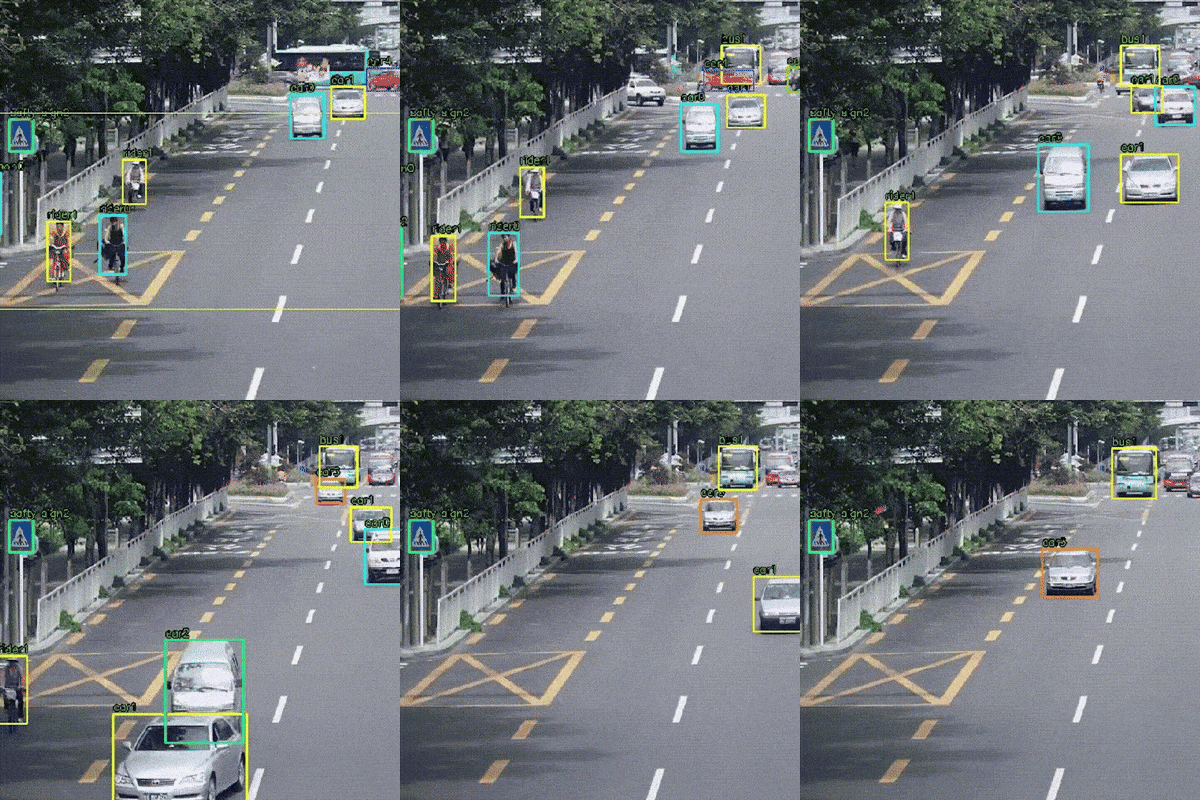
Video annotation is used in creating training data sets for high visualization training in deep learning and machine learning models. Video annotation services involve adding metadata to videos which can be used to train Computer Vision models to detect and identify moving objects. It involves a very intensive process of processing, analyzing and understanding every frame in a video.
We use highly specialized tools and a dedicated team of experts to ensure your video annotation needs are fulfilled. Our state of the art video annotation service lets you train your algorithm to perform a variety of tasks that are required for your AI technology and computer systems.
Purpose of Video Annotation Services
- Detecting Objects: Identifying objects of interest through each frame and making them recognizable to machines.
- Localize Objects: Locating main objects in an image where multiples objects might be visible at the same time
- Track Objects: Detecting and recognizing a wide variety of objects that are in motion.
- Track Activities: Training computer vision based AI to track human activities and estimate poses.
How Video Annotation Works
Labelling or annotation makes the object of interest recognizable while feeding it into an algorithm. In video annotation, this means making moving objects recognizable and learning their movements through computer vision. The size and complexity of data contained within a video makes annotation a formidable task. There are two methods to approach video annotation -
- Single Image Method: In this method the video is broken down into a series of image frames which are then annotated one frame at a time. This method is time consuming and inefficient and can lead to lesser quality due to chances of mislabelling when moving through the hundreds or sometimes, thousands of image frames.
- Continuous Frame Method: In this method, we will make use of automation tools to accurately streamline the video annotation process. The computer will analyze pixels of corresponding frames and predict its movement throughout the whole video. This will preserve the continuity and flow of information captured from the video.
- Incorporating automation: components in the process can increase the accuracy and reliability of the data at a much higher efficiency.
Video Annotation In Self Driving Vehicles:
Video annotation helps autonomous vehicles to recognize and track objects like vehicles, pedestrians, traffic lanes, lights, etc.
Medical Video AI Annotation:
With deep learning technology, AI makes use of video annotations to identify possible diseases and prepare reports. It can assist medical experts in repetitive activities that are homogenous and prone to errors by increasing quality and efficiency.
Video Annotation In Sports:
Video annotation is used in training AI or machine learning models to track the actions of athletes during sport events which can then be used to extract valuable information such as analyzing performance and predicting injuries.
We have assembled a team of professionals that provide our customers with consistently reliable and comprehensive video annotation tools and services. We provide top quality training data for exceptional AI and machine learning projects through a combination of exceptional human intelligence and state of the art technology. Give a boost to your project efficiency and gain access to our testing ground for existing models with our labeling tool.
Frequently Asked Questions
Find answers to the most commonly asked questions about our annotation services.