
May 2026

3d LiDAR annotations, autonomous vehicles, image annotations

LiDAR Annotation vs Image Annotation in Self-Driving Cars

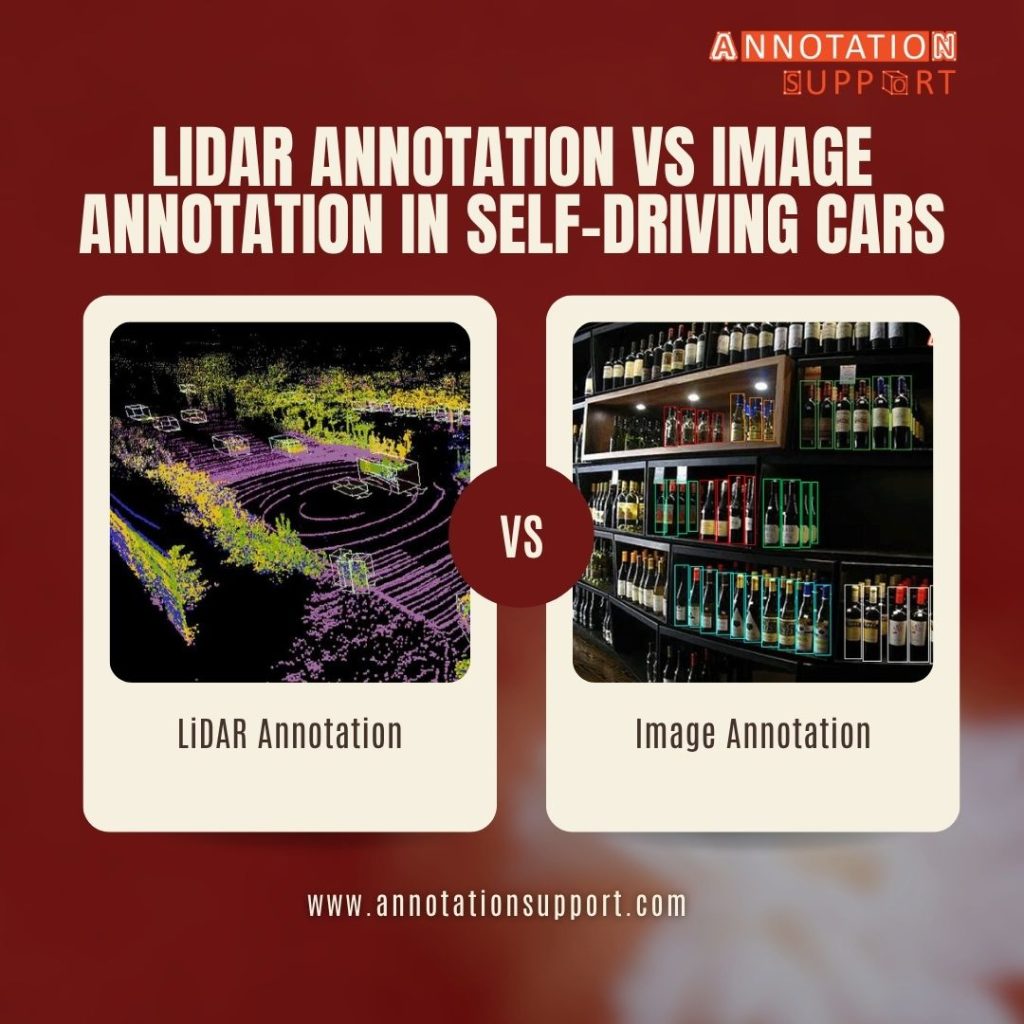
Humans have more to rely on experience and some labeling spiritually than autonomous vehicles, which need huge quantities of labeled data to comprehend everything around them. The two crucial data types applied in training such systems are LiDAR and image data. Both are vital, but have different functions along with carrying various benefits and difficulties. What is LiDAR Annotation? LiDAR annotation is the process of tagging 3D point cloud data collected with LiDAR sensor. These sensors produced laser pulses and then calculated the time elapsed between the pulse being sent and the pulse returning in order to develop an elaborate 3D image of the surrounding area. Key Features of LiDAR Annotation Common LiDAR Annotation Techniques: What is Image Annotation? Labeling 2D visual data acquired from cameras is known as Image annotation. This refers to identification of objects, lane marks, pedestrians, traffic sign and among the others. Key Features of Image Annotation: Common Image Annotation Techniques: Key Differences: LiDAR vs Image Annotation Feature LiDAR Annotation Image Annotation Data Type 3D Point Cloud 2D Images Depth Perception High accuracy Limited (requires estimation) Lighting Conditions Works in low light/night Affected by lighting Detail Level Less texture detail Rich visual detail Cost Expensive More affordable Complexity High (requires expertise) Moderate Use Cases Distance measurement, object tracking Object recognition, classification Advantages of LiDAR Annotation Advantages of Image Annotation Challenges in LiDAR Annotation Challenges in Image Annotation In what way do Autonomous Vehicles use Both? Self-driving systems are not actually relying on 1 data type alone but using several types (sensor fusion) to enhance the accuracy and safety. Sensor Fusion Benefits: Use cases on self-driving cars LiDAR Annotation is best for: Image Annotation is best for: What is the best choice? Truthfully it is this: it’s not about just one. Conclusion LiDAR and Image annotation are key foundations of self-driving technology. LiDAR offers unparalleled spatial accuracy, and image annotation offers rich visual understanding. These combine to create safer smart and reliable self driving.

image annotations, medical annotation

Medical Image Annotation for Radiology AI: A Complete Guide

In the construction of accurate and reliable AI models for radiology, medical image annotation is crucial. Annotated datasets form the foundation of numerous crucial and contemporary AI solutions in the healthcare sector, such as tumor detection or fracture identification. What is Medical image annotation? Medical image annotation involves marking, labeling, or naming the medical images including ultra sounds, MRIs, CT scans and X-rays for training AI and machine learning models. These annotations aid in pattern recognition, the identification of abnormalities and may assist radiologists with diagnosis, which may benefit algorithms. Why is Annotation Important in Radiology AI? The data quality and annotations play a crucial role in the development of Radiology AI. AI models are unable to learn properly without accurate labelling. Key benefits include: Methods of medical imaging employed: There are a number of different imaging modalities that are used with radiology AI, such as: Types of Annotation Techniques 1. Bounding Box Annotation Marks areas of interest (like tumours/lesions). 2. Semantic Segmentation Structures such as organs or tissues are identified and each pixel is labelled with this information. 3. Instance Segmentation Discriminates between multiple objects of identical class objects (such as multiple tumors). 4. Keypoint Annotation                         Identifies parts of the body. 5. 3D Annotation Typical for Volumetric Data such as CT and MRI scan. Annotation Workflow Medical image annotation is a typical workflow process including: Challenges in Medical Image Annotation Annotation is challenging because it: Providing high quality annotation – Best Practices To be accurate and efficient: Use Cases of Radiology AI Future of Medical Image Annotation Current factors driving the future are: The increased adoption of AI across the healthcare spectrum has increased the need for the quality of the annotated medical data. Why Choose a Professional Annotation Partner? Here are some advantages of outsourcing medical image annotation:  Annotation Support is dedicated to offering accurate and secure medical annotation services especially for the development of AI solutions. Conclusion Medical image captioning is the basic of AI in radiology. Healthcare organizations can create powerful AI models for diagnostics, efficiency and ultimately, lives saved, with precise labeling.

Scroll to Top