
image annotations

3d LiDAR annotations, autonomous vehicles, image annotations

LiDAR Annotation vs Image Annotation in Self-Driving Cars

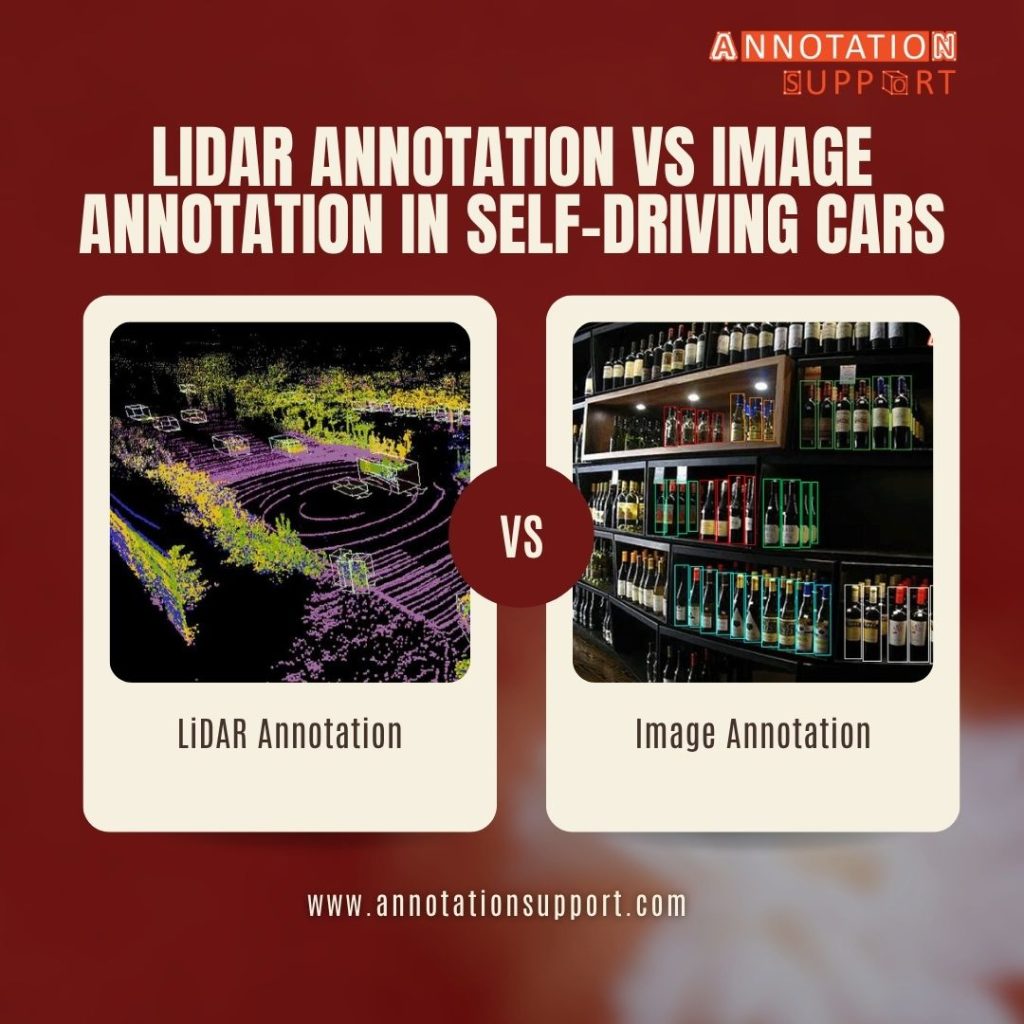
Humans have more to rely on experience and some labeling spiritually than autonomous vehicles, which need huge quantities of labeled data to comprehend everything around them. The two crucial data types applied in training such systems are LiDAR and image data. Both are vital, but have different functions along with carrying various benefits and difficulties. What is LiDAR Annotation? LiDAR annotation is the process of tagging 3D point cloud data collected with LiDAR sensor. These sensors produced laser pulses and then calculated the time elapsed between the pulse being sent and the pulse returning in order to develop an elaborate 3D image of the surrounding area. Key Features of LiDAR Annotation Common LiDAR Annotation Techniques: What is Image Annotation? Labeling 2D visual data acquired from cameras is known as Image annotation. This refers to identification of objects, lane marks, pedestrians, traffic sign and among the others. Key Features of Image Annotation: Common Image Annotation Techniques: Key Differences: LiDAR vs Image Annotation Feature LiDAR Annotation Image Annotation Data Type 3D Point Cloud 2D Images Depth Perception High accuracy Limited (requires estimation) Lighting Conditions Works in low light/night Affected by lighting Detail Level Less texture detail Rich visual detail Cost Expensive More affordable Complexity High (requires expertise) Moderate Use Cases Distance measurement, object tracking Object recognition, classification Advantages of LiDAR Annotation Advantages of Image Annotation Challenges in LiDAR Annotation Challenges in Image Annotation In what way do Autonomous Vehicles use Both? Self-driving systems are not actually relying on 1 data type alone but using several types (sensor fusion) to enhance the accuracy and safety. Sensor Fusion Benefits: Use cases on self-driving cars LiDAR Annotation is best for: Image Annotation is best for: What is the best choice? Truthfully it is this: it’s not about just one. Conclusion LiDAR and Image annotation are key foundations of self-driving technology. LiDAR offers unparalleled spatial accuracy, and image annotation offers rich visual understanding. These combine to create safer smart and reliable self driving.

image annotations, medical annotation

Medical Image Annotation for Radiology AI: A Complete Guide

In the construction of accurate and reliable AI models for radiology, medical image annotation is crucial. Annotated datasets form the foundation of numerous crucial and contemporary AI solutions in the healthcare sector, such as tumor detection or fracture identification. What is Medical image annotation? Medical image annotation involves marking, labeling, or naming the medical images including ultra sounds, MRIs, CT scans and X-rays for training AI and machine learning models. These annotations aid in pattern recognition, the identification of abnormalities and may assist radiologists with diagnosis, which may benefit algorithms. Why is Annotation Important in Radiology AI? The data quality and annotations play a crucial role in the development of Radiology AI. AI models are unable to learn properly without accurate labelling. Key benefits include: Methods of medical imaging employed: There are a number of different imaging modalities that are used with radiology AI, such as: Types of Annotation Techniques 1. Bounding Box Annotation Marks areas of interest (like tumours/lesions). 2. Semantic Segmentation Structures such as organs or tissues are identified and each pixel is labelled with this information. 3. Instance Segmentation Discriminates between multiple objects of identical class objects (such as multiple tumors). 4. Keypoint Annotation                         Identifies parts of the body. 5. 3D Annotation Typical for Volumetric Data such as CT and MRI scan. Annotation Workflow Medical image annotation is a typical workflow process including: Challenges in Medical Image Annotation Annotation is challenging because it: Providing high quality annotation – Best Practices To be accurate and efficient: Use Cases of Radiology AI Future of Medical Image Annotation Current factors driving the future are: The increased adoption of AI across the healthcare spectrum has increased the need for the quality of the annotated medical data. Why Choose a Professional Annotation Partner? Here are some advantages of outsourcing medical image annotation:  Annotation Support is dedicated to offering accurate and secure medical annotation services especially for the development of AI solutions. Conclusion Medical image captioning is the basic of AI in radiology. Healthcare organizations can create powerful AI models for diagnostics, efficiency and ultimately, lives saved, with precise labeling.

dataannotations, image annotations

An In-Depth Exploration of Data Annotation Services in Precision Agriculture

Modern farming practices employ data analytics to enhance agricultural output through data-based resource management while achieving sustainability goals. The core capability which enables precision agriculture depends on data annotation since it allows machine learning (ML) and artificial intelligence (AI) models to correctly understand agricultural information. The analysis examines data annotation services in precision agriculture by studying their function together with their difficulties and advantages. 1. Understanding Data Annotation in Precision Agriculture Data annotation serves as the practice of tagging unprocessed agricultural information through images and sensor outputs and satellite images for AI model education purposes. The defined labelling method enables AI systems to detect patterns which help generate proper predictions about crop health together with soil quality and pest information. Types of Data Annotation in Precision Agriculture Image Annotation: The annotation tool Bounding Boxes enables the detection of crops and weeds as well as pests together with diseases within aerial or field images. Semantic Segmentation: Semantic Segmentation enables recognition between plant species, water bodies as well as soil types in a single image. Instance Segmentation: This method separates individual objects from each other while keeping them in the same class (multiple diseased plants serve as an example). Key Point & Landmark Annotation: Key Point and Landmark Annotation serves as a tool which detects crop development stages and recognizes precursors of stress indicators. Text and Audio Annotation 2. Applications of Data Annotation in Precision Agriculture Crop Health Monitoring The AI analyses data which consists of annotated satellite and drone images to recognize disease indicators together with nutrient problems and moisture issues in agricultural fields. Algorithms that assess multispectral images undergo annotation functions to anticipate crop damage occurrences in advance. Weed & Pest Detection The ability of AI depends on data annotation to separate crops from weeds which enables the operation of automated weeding systems through smart sprayers. Almost similarly the detection of pests happens through annotated images which activate pest controlling procedures. Yield Prediction AI models produce accurate yield forecasts when they are supplied with historical yield tags together with environmental condition information. The system enables farmers to use data-based information for scheduling plantings and managing resource distribution. Precision Irrigation & Soil Health Analysis Soil sensors annotated by AI systems help design better irrigation plans that water crops correctly and prevent water loss from the fields. Automated Machinery & Robotics Robot farm equipment depends on labelled image and LiDAR data to drive safely through farmland. Machine systems depend on precise annotations to separate crop plants from other farm items. 3. Benefits of Data Annotation Services in Precision Agriculture Improved AI Accuracy The right labelling of datasets helps AI models work better which leads to better crop health observation and yield estimation plus automatic farm activities. Cost & Resource Efficiency The ability of AI to detect more effective farming methods helps farmers save resources plus reduces operational costs and makes their operations more sustainable. Scalability & Automation Management of extensive farmland becomes easier through data annotation as it enables scaled results for efficient farming operations. Decision Support for Farmers Data annotation helps farmers access live data through their AI dashboards to take better decisions. 4. Future Trends in Data Annotation for Precision Agriculture AI-Assisted Annotation AI systems now help us prepare large datasets, but farm experts enhance the work to bring better results faster. Blockchain for Data Transparency Researchers want to protect and validate agricultural data through blockchain technology to build up trust in the annotation process. Edge AI for On-Farm Data Processing Sensors used in IoT and drones now process on-farm data in real-time by installing AI outside the cloud network. Collaboration with Farmers Farmers take part in data annotation more often through smartphone apps which help improve how datasets are organized. Conclusion Data annotation helps farmers leverage AI systems for better farming results through farm monitoring and automated machine use with their data predictions. Even though harvesting high-quality data on a large-scale facing problem today they can still succeed by getting help from AI annotation systems and blockchain security technology. Quality data annotation services will help the agriculture sector reach its AI potential and bring about more successful results.

image annotations

Image Annotation for Sentiment Analysis: Unlocking Insights from Visual Data

Labelling image for sentiment analysis represents the attachment of sentiment or emotion tags to images aimed at drawing conclusions on visual data. Here’s how it can be done effectively: Define Sentiment Categories: In case of your image dataset, get the sentiment or emotion categories you are interested in. The pool of emotions can for example include: positive, negative, neutral, happy, sad, angry, surprised, etc. Where each category is defined by certain guidelines for annotators. Annotate Emotions or Sentiments: If you are using the annotation tools then, label images as any of the positive or negative emotions or sentiment. Markers can be placed around regions of interest (e.g., faces) and labels can be assigned to the regions to define whether the sentiment is positive, negative or neutral. Consider Context: Remembering the image context when assigning an emotion label is suffice. Likewise, a person looking happy smiling in a group picture might mean that he is just happy, but the general picture of the event (e.g., a funeral) provide interesting aspects. Annotate Objects and Scenes: Besides facial expressions, picturing other objects or scenes in the photograph that show the necessary expression is also advisable. Consider another thing, like a sunny beach where the positive feeling is likely to be observed, or a dark alleyway where negative feelings are to be expected. Account for Ambiguity: Understand that sentiment annotation may include subjectivity and inaccuracy. Write up the rules for using them in the instances of disagreement among annotators. At the same time, acknowledge the annotators’ power to use their judgment and guarantee the consistency. Use Multi-Modal Annotations: Make image annotations in combination with some text annotations that include indicating the sentiment mood (e.g., caption, tags) to provide a comprehensive context for sentiment analysis. This integrative approach makes sentiment more precise and diverse, thus also brightens the image. Validate Annotations: Check the rightness of annotations by using human judgments and performing qualified tasks for verifying it. It might be conducted by examining a knot of inspected images either manually or by applying validation routines that look for errors. Iterative Improvement: Regard annotation services as iterative process and enrich your guidelines on annotating on a periodic basis with the help of observations and ideas that are generated during the analysis. Keep the annotated data under review to monitor the places for making corrections and update the guidelines wherever necessary. Account for Cultural Differences: Take into account that the sentiment is affected mostly by the cultural peculiarities and might not convey the similar meaning in the space. Analyse the cultural context of the audience you are targeting, and make sure that the sentiment categories and the schemes of annotation are adequate and relevant. Ensure Privacy and Ethical Considerations: In case you do the annotations, respect the privacy and ethical considerations when it comes to annotating an image, especially when it contains sensitive information or personal data. Build some person identifiers anonymity and face covering measures if necessary. Implementing the best practices discussed above, you may successfully annotate images for sentiment analysis with the aim of converting visual information into actionable business insights that will make the product and users better. To know more about Annotation support’s image annotation services, please contact us at https://www.annotationsupport.com/contactus.php

Scroll to Top