autonomous vehicles

autonomous vehicles, data annotation services

What Powers Autonomous Vehicles? A Deep Dive into Data Annotation

The vision of completely self-driving vehicles is on the verge of becoming a reality. From self-driving cars navigating busy city streets to autonomous trucks transporting goods across continents, artificial intelligence (AI) is revolutionizing the transportation industry. Data annotation is one of the key requirements that most people don’t think about when designing a safe and smart autonomous vehicle. Data annotation creates the annotated datasets that allow AI models to interpret road users, traffic, hazards and make real-time driving decisions. The lack of precise and accurate data would make it difficult for an autonomous vehicle to “see” what is happening around it. This blog examines how data annotation plays a crucial role in the development of autonomous vehicles, the types of data annotations that are used, and the importance of having high-quality labeled data when creating safer and smarter mobility solutions. Understanding Autonomous Vehicles Autonomous vehicles (AVs) process the surrounding environment and interact with it using a combination of sensors, cameras, LiDAR, radar, GPS, and AI algorithms. These systems process huge amounts of data to detect vehicles, forecast their trajectory and make the most informed driving decisions. There are various degrees of vehicle automation – from driver assistance to full automation (Level 5). More and more, as autonomy grows, needs for high accuracy and diversity of annotated datasets becomes more and more important. Why Data Annotation Is Critical for Autonomous Vehicles? Autonomous driving systems are dependent on supervised machine learning and deep learning models, which need to be trained with very well labelled data. Each pedestrian, traffic sign, lane marking, vehicle, cyclist and obstacle should be properly labeled and identified so the AI can recognize similar objects in real-world driving scenarios. High-quality data annotation helps enable autonomous vehicles to do the following: These AI models rely heavily on the quality, consistency, and diversity of the annotated training data—the quality of this data is directly correlated to the accuracy of the AI model. Types of Data Annotation Used in Autonomous Vehicle Development 1. Bounding Box Annotation One of the most popular annotation approaches in autonomous driving is to use bounding boxes. They assist AI systems in detecting and pinpointing objects in frames and images of videos. The most common objects that are annotated are: The bounding boxes help form the basis for an algorithm that can detect objects in the environment, allowing the vehicle to identify its surroundings in real time. 2. Semantic Segmentation Semantic segmentation distils all the information in an image into a class label for each pixel, enabling self-driving cars to decipher entire scenes, not just individual objects. Typical classes include: This detailed knowledge enables AI systems to differentiate between areas that can be driven through and areas that cannot be driven through. 3. Instance Segmentation Instance segmentation is different from semantic segmentation in that it segments one instance of an object at a time even in cases where there are multiple instances of the same object. For instance, each vehicle or pedestrian gets a distinct annotation which helps to track them and avoid collisions. 4. Polygon Annotation The polygon annotation is more accurate than the rectangle annotation for representing irregularly shaped objects. It’s frequently employed for: This will render more precise boundaries of objects and hence improve computer vision results. 5. Polyline Annotation A requirement to map road structures and navigation paths is polyline annotation. It is used to annotate: Lane detection is a crucial component of lane keeping, lane changing and path planning. 6. 3D Cuboid Annotation Spatial awareness is a crucial component for autonomous vehicles, and 3D cuboid annotation is essential. Cuboids give information about: These annotations assist AI to determine where nearby vehicles and objects are and how they’re moving. 7. LiDAR Annotation LiDAR sensors produce a million or more 3D point cloud measurements. These point clouds are then used for structured training data through specialized annotation. LiDAR annotation includes: LiDAR data does not only enable the improvement of the accuracy of perception, especially in low-light situations, but it also brings other advantages. 8. Radar Annotation When paired with camera and LiDAR data, radar provides accurate distance and speed measurement of objects in weather conditions where cameras and LiDAR are not effective, like in the rain, fog, and snow. Radar annotation is essential for the integration of various sensor data in AI systems, leading to more accurate perception. 9. Video Annotation Temporal understanding is a critical issue for autonomous driving. Video annotation enables: The continuous frame by frame annotation trains the AI to learn the movement of objects over time. 10. Keypoint Annotation Keypoint annotation is a type of annotation that locates specific features on objects. Examples include: These annotations are useful to support pose estimation and behavior prediction. Sensors Used in Autonomous Vehicles These include: AI systems can make accurate decisions by fusing information from multiple sources, which is known as sensor fusion. Conclusion Autonomous vehicles are changing the future of mobility, and the smartness of these vehicles relies on quality annotated data. Data annotation is the backbone that enables the proper perception, navigation and decision making for data, ranging from bounding boxes and semantic segmentation to LiDAR point cloud labelling and multi-object tracking. An experienced provider of the annotations will provide accurate and extensive and scalable datasets to train the AI models. Tailored for the automotive industry, AI and mobility startups, Annotation Support offers trusted enterprise-grade data annotation services to expedite the development of autonomous vehicles. Be you developing advanced driver assistance systems (ADAS), autonomous delivery vehicles, or a full self-driving platform, high-quality data annotation plays a pivotal role in ensuring safer, smarter, and more reliable mobility solutions.
3d LiDAR annotations, autonomous vehicles, image annotations

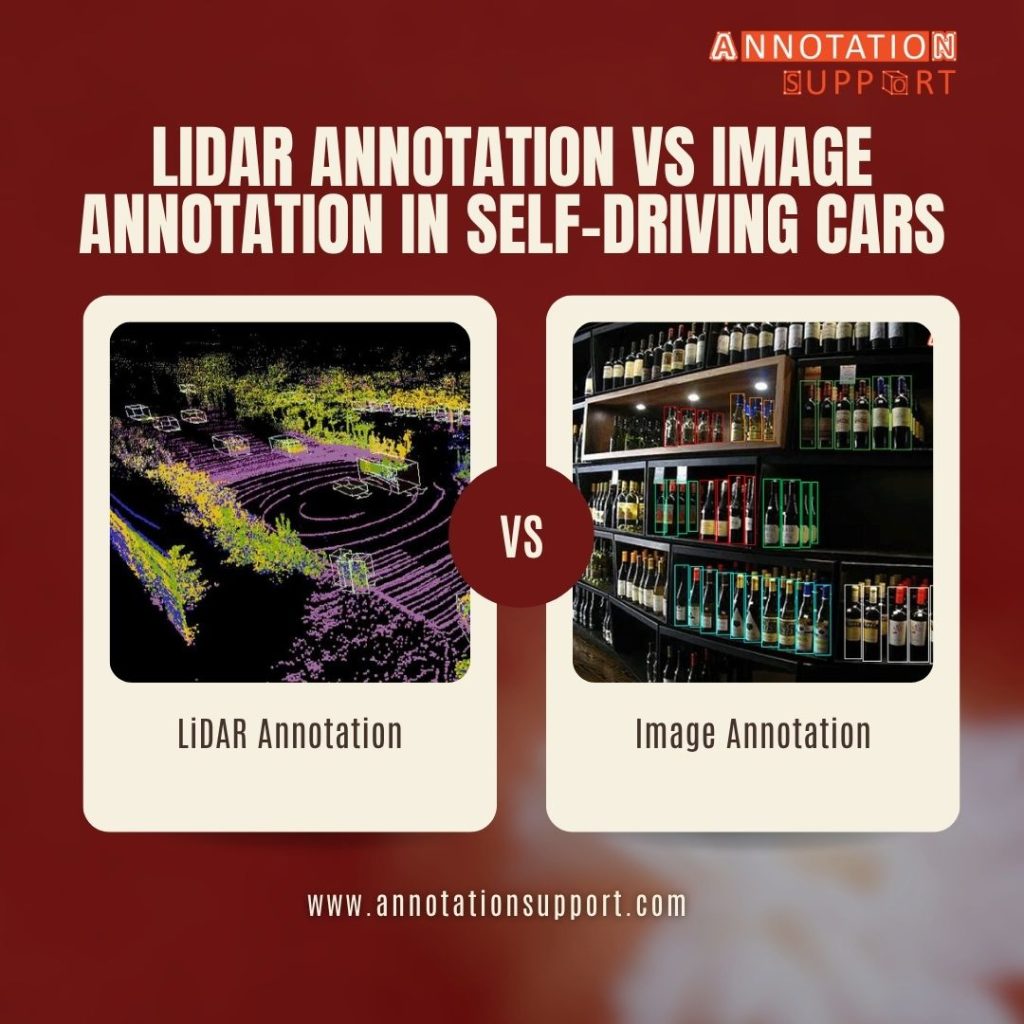
LiDAR Annotation vs Image Annotation in Self-Driving Cars

Humans have more to rely on experience and some labeling spiritually than autonomous vehicles, which need huge quantities of labeled data to comprehend everything around them. The two crucial data types applied in training such systems are LiDAR and image data. Both are vital, but have different functions along with carrying various benefits and difficulties. What is LiDAR Annotation? LiDAR annotation is the process of tagging 3D point cloud data collected with LiDAR sensor. These sensors produced laser pulses and then calculated the time elapsed between the pulse being sent and the pulse returning in order to develop an elaborate 3D image of the surrounding area. Key Features of LiDAR Annotation Common LiDAR Annotation Techniques: What is Image Annotation? Labeling 2D visual data acquired from cameras is known as Image annotation. This refers to identification of objects, lane marks, pedestrians, traffic sign and among the others. Key Features of Image Annotation: Common Image Annotation Techniques: Key Differences: LiDAR vs Image Annotation Feature LiDAR Annotation Image Annotation Data Type 3D Point Cloud 2D Images Depth Perception High accuracy Limited (requires estimation) Lighting Conditions Works in low light/night Affected by lighting Detail Level Less texture detail Rich visual detail Cost Expensive More affordable Complexity High (requires expertise) Moderate Use Cases Distance measurement, object tracking Object recognition, classification Advantages of LiDAR Annotation Advantages of Image Annotation Challenges in LiDAR Annotation Challenges in Image Annotation In what way do Autonomous Vehicles use Both? Self-driving systems are not actually relying on 1 data type alone but using several types (sensor fusion) to enhance the accuracy and safety. Sensor Fusion Benefits: Use cases on self-driving cars LiDAR Annotation is best for: Image Annotation is best for: What is the best choice? Truthfully it is this: it’s not about just one. Conclusion LiDAR and Image annotation are key foundations of self-driving technology. LiDAR offers unparalleled spatial accuracy, and image annotation offers rich visual understanding. These combine to create safer smart and reliable self driving.

autonomous vehicles

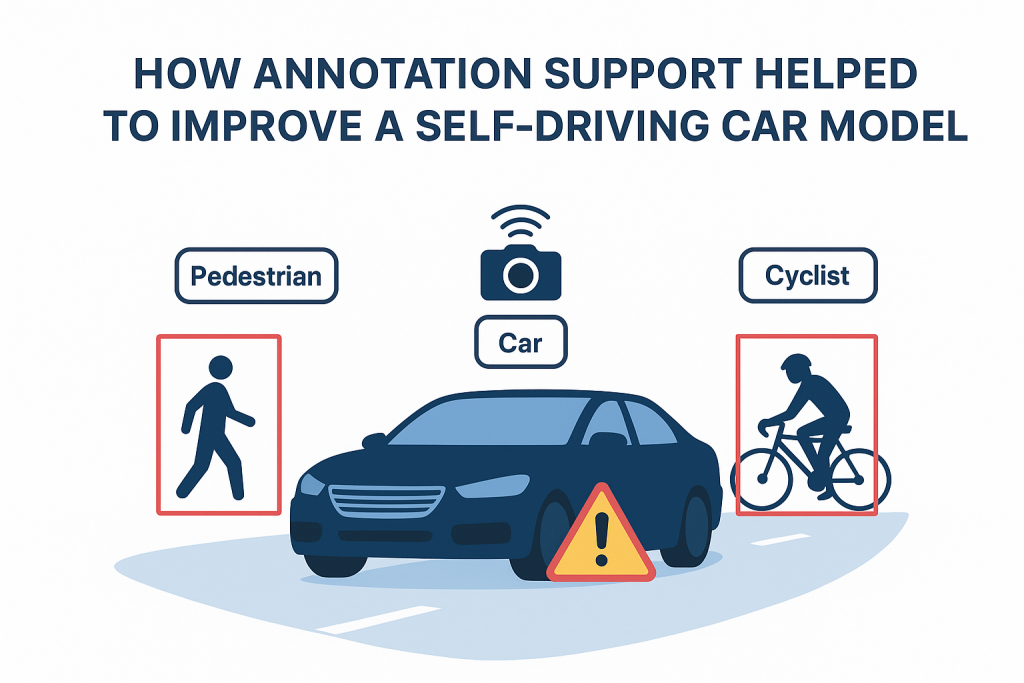
How Annotation Support Helped to Improve a Self-Driving Car Model?

Introduction Self-driving vehicles are designs that combine the forces, such as AI models, which are trained to understand the world in the same way that a human does, i.e. recognising roads, cars, pedestrians, traffic signs, etc. in real time. Highly labelled data sets are the main determinant in creating models that can be accurate. Here know how a poorly performing autonomous driving system turned into a safety, more reliable system through professional annotation services of Annotation Support. 1. The Challenge An autonomous vehicle company faced: What ails the fundamental dilemma? Improper and dissimilar data labelling of a previous outsourced company. 2. Project Goals Annotation Support allocated the following techniques: 3. Annotation Techniques Used by Annotation Support Bounding Boxes & Polygons – cars, trucks, buses, pedestrians and cyclists Semantic Segmentation – Pixel Level label of roads, sidewalks, curbs, lanes lines LiDAR 3D Point Cloud Annotation depth / distance – LiDAR labelling Keypoint Annotation – Wheel locations, headlight locations, locations of joints of pedestrians to make predictions of moving direction Occlusion & Truncation Labels -Marking the truncated or occluded objects of the detection training 4. Quality Control Measures 5. Results One quarter-year later, having been re-annotated, and the data set scaled up: 6. Learning Key Points Conclusion Annotation Support does not only deliver labeled data–clean, consistent, context-aware annotations were directly contributed to better results in the AI judgment. In autonomous driving, the quality of the data obtained about perception may mean the difference between a near miss and accidents. With high-quality annotations, the self-driving car model became safer, faster, and more reliable—bringing it one step closer to real-world deployment.

autonomous vehicles, bounding box annotations, polygon annotation

Top Annotation Techniques Used in Autonomous Vehicle Datasets

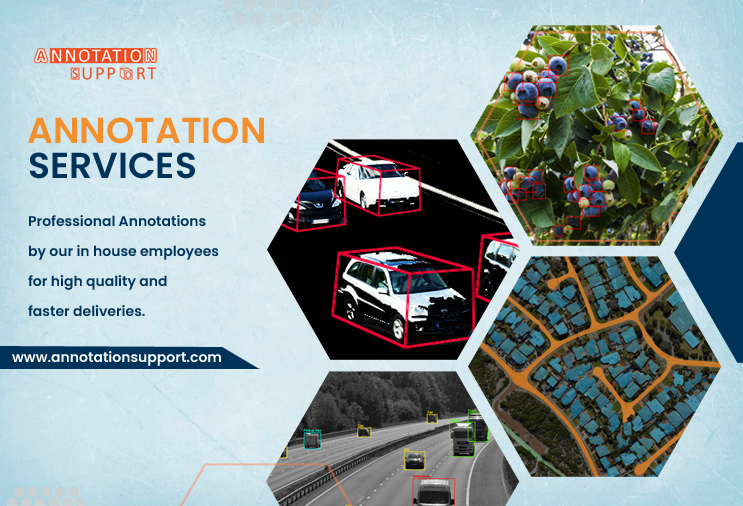
Autonomous vehicles rely heavily on high-quality annotated data to interpret the world around them. From understanding traffic signs to detecting pedestrians, the success of these vehicles hinges on the precision of data labelling. To train these systems effectively, several annotation techniques are used to handle the wide range of data types collected from cameras, LiDAR, radar, and other sensors. Below are the top annotation techniques commonly used in autonomous vehicle datasets: 1. 2D Bounding Boxes Purpose: To find out and place objects (like vehicles, pedestrians, road signs) in 2D square video. How it Works: In the camera images, box shaped figures encircle objects of interest in the form of rectangles. A label is placed on each box (e.g. car, bicycle, stop sign). Use Cases: 2. 3D Bounding boxes Purpose: To sense the space and the position of the objects in the 3D space. How it Works: In 3D point cloud dataset (typically LiDAR) cuboids are labelled to indicate a 3D object (depth, height, width, and rotation). Use Cases: 3. Semantic Segmentation Purpose: To label each pixel (2D) or point (3D) in a point cloud or image, to a class. How it Works: The pixels of an image are classified based on the object which they are attached to (e.g. road, sidewalk, walking person). Use Cases: 4. Instance Segmentation Purpose: To recognize individual objects and boundaries, even when it comes to objects belonging to the same class. How it Works: Intertwines object detection with a semantic segmentation model to mark every object instance in different manners. Use Cases: 5. Keypoint Annotation Purpose: Indicate certain important locations on items (e.g. at joints of people, corners of traffic signs). How it Works: Keypoints where used are tagged at the important parts of the body such as elbows, knees, wheels of a vehicle or head lamps among others. Use Cases: 6. Lane Annotation Purpose: To precisely identify and mark lanes and lane divisions during the process of driving. How it Works: In detected lanes in images, curves or lines are drawn on top of these lanes. Commonly lines are drawn on top of these lanes via polynomial fitting of curved roads. Use Cases: 7. Cuboid Annotation for Sensor Fusion Purpose: To combine 2D and 3D annotations to improve accuracy through several sensors (camera + LiDAR). How it Works: LiDAR 3D annotations are projected to obtain refinements on 2D camera images with multiple sensor inputs. Use Cases: 8. Polygon Annotation Purpose: To label the objects that have odd shapes and sharp edges. How it Works: The polygons will be a draw around the contours of the objects instead of the bounding boxes, a rectangle. Use Cases: 9. Trajectory Annotation Purpose: To trace the motion-trajectories of dynamic objects between frames. How it Works: The positions of objects are tagged throughout the period to comprehend the velocity, direction and motion in future. Use Cases: Conclusion Proper labelling is the mainframe of the development of autonomous vehicles. All the methods of annotations have their own use, either it is to identify a pedestrian in a crosswalk, or a drivable route in front. With the world moving towards completely autonomous industries, these methods of annotations keep getting more accurate, quicker and scalable with AI-aided tools and with the assistance of human-in-the-loop frameworks. It is not only the training of a car but actually the training of a machine to comprehend the complications of the real world in driving.

annotation company, autonomous vehicles, data annotation services

Why “Annotation Support” Stands Among the Top Data Annotation Companies Globally?

“Annotation Support” has won a notable place among global data annotation providers by always delivering high-quality, flexible, and adjustable solutions. Let’s look at the reasons it separates itself from the other top companies in the industry. 1. Industry-Specific Expertise “Annotation Support” covers in-depth information in many different industries. As a result, clients can expect data that addresses their industries in particular. 2. Wide Range of Annotation Services From the basic step of rendering as 2D boxes to following the movement of 3D objects, “Annotation Support” handles many types of object detection. The wide range of services attracts clients from all kinds of AI training industries. 3. Quality-Driven Process “Annotation Support” has these features: For models to succeed, accuracy and consistency need to be found in its services. 4. Scalable Workforce and Tools No matter if it is a small startup or a big enterprise, “Annotation Support” can match the needs of any organization. As a result, different projects will benefit from flexibility and lower costs. 5. Secure and Confidential Operations Ensuring security is very important in such projects. “Annotation Support” brings the following benefits: For this reason, our services matter most to companies in healthcare, fintech, and legal tech. 6. Global Clientele and Proven Track Record “Annotation Support” has: Global reach and a strong track record reinforce its credibility. 7. Innovation and Customization It allows data to be labelled with a goal of improving AI in the future. That’s why “Annotation Support” is notable; it gathers domain expertise, looks after technological aspects, tests rigorously for quality, addresses security matters, and delivers results internationally. Because of these strengths, companies prefer to use it when developing dependable, error-free, and expandable AI systems.

Scroll to Top