
data annotation services

autonomous vehicles, data annotation services

What Powers Autonomous Vehicles? A Deep Dive into Data Annotation

The vision of completely self-driving vehicles is on the verge of becoming a reality. From self-driving cars navigating busy city streets to autonomous trucks transporting goods across continents, artificial intelligence (AI) is revolutionizing the transportation industry. Data annotation is one of the key requirements that most people don’t think about when designing a safe and smart autonomous vehicle. Data annotation creates the annotated datasets that allow AI models to interpret road users, traffic, hazards and make real-time driving decisions. The lack of precise and accurate data would make it difficult for an autonomous vehicle to “see” what is happening around it. This blog examines how data annotation plays a crucial role in the development of autonomous vehicles, the types of data annotations that are used, and the importance of having high-quality labeled data when creating safer and smarter mobility solutions. Understanding Autonomous Vehicles Autonomous vehicles (AVs) process the surrounding environment and interact with it using a combination of sensors, cameras, LiDAR, radar, GPS, and AI algorithms. These systems process huge amounts of data to detect vehicles, forecast their trajectory and make the most informed driving decisions. There are various degrees of vehicle automation – from driver assistance to full automation (Level 5). More and more, as autonomy grows, needs for high accuracy and diversity of annotated datasets becomes more and more important. Why Data Annotation Is Critical for Autonomous Vehicles? Autonomous driving systems are dependent on supervised machine learning and deep learning models, which need to be trained with very well labelled data. Each pedestrian, traffic sign, lane marking, vehicle, cyclist and obstacle should be properly labeled and identified so the AI can recognize similar objects in real-world driving scenarios. High-quality data annotation helps enable autonomous vehicles to do the following: These AI models rely heavily on the quality, consistency, and diversity of the annotated training data—the quality of this data is directly correlated to the accuracy of the AI model. Types of Data Annotation Used in Autonomous Vehicle Development 1. Bounding Box Annotation One of the most popular annotation approaches in autonomous driving is to use bounding boxes. They assist AI systems in detecting and pinpointing objects in frames and images of videos. The most common objects that are annotated are: The bounding boxes help form the basis for an algorithm that can detect objects in the environment, allowing the vehicle to identify its surroundings in real time. 2. Semantic Segmentation Semantic segmentation distils all the information in an image into a class label for each pixel, enabling self-driving cars to decipher entire scenes, not just individual objects. Typical classes include: This detailed knowledge enables AI systems to differentiate between areas that can be driven through and areas that cannot be driven through. 3. Instance Segmentation Instance segmentation is different from semantic segmentation in that it segments one instance of an object at a time even in cases where there are multiple instances of the same object. For instance, each vehicle or pedestrian gets a distinct annotation which helps to track them and avoid collisions. 4. Polygon Annotation The polygon annotation is more accurate than the rectangle annotation for representing irregularly shaped objects. It’s frequently employed for: This will render more precise boundaries of objects and hence improve computer vision results. 5. Polyline Annotation A requirement to map road structures and navigation paths is polyline annotation. It is used to annotate: Lane detection is a crucial component of lane keeping, lane changing and path planning. 6. 3D Cuboid Annotation Spatial awareness is a crucial component for autonomous vehicles, and 3D cuboid annotation is essential. Cuboids give information about: These annotations assist AI to determine where nearby vehicles and objects are and how they’re moving. 7. LiDAR Annotation LiDAR sensors produce a million or more 3D point cloud measurements. These point clouds are then used for structured training data through specialized annotation. LiDAR annotation includes: LiDAR data does not only enable the improvement of the accuracy of perception, especially in low-light situations, but it also brings other advantages. 8. Radar Annotation When paired with camera and LiDAR data, radar provides accurate distance and speed measurement of objects in weather conditions where cameras and LiDAR are not effective, like in the rain, fog, and snow. Radar annotation is essential for the integration of various sensor data in AI systems, leading to more accurate perception. 9. Video Annotation Temporal understanding is a critical issue for autonomous driving. Video annotation enables: The continuous frame by frame annotation trains the AI to learn the movement of objects over time. 10. Keypoint Annotation Keypoint annotation is a type of annotation that locates specific features on objects. Examples include: These annotations are useful to support pose estimation and behavior prediction. Sensors Used in Autonomous Vehicles These include: AI systems can make accurate decisions by fusing information from multiple sources, which is known as sensor fusion. Conclusion Autonomous vehicles are changing the future of mobility, and the smartness of these vehicles relies on quality annotated data. Data annotation is the backbone that enables the proper perception, navigation and decision making for data, ranging from bounding boxes and semantic segmentation to LiDAR point cloud labelling and multi-object tracking. An experienced provider of the annotations will provide accurate and extensive and scalable datasets to train the AI models. Tailored for the automotive industry, AI and mobility startups, Annotation Support offers trusted enterprise-grade data annotation services to expedite the development of autonomous vehicles. Be you developing advanced driver assistance systems (ADAS), autonomous delivery vehicles, or a full self-driving platform, high-quality data annotation plays a pivotal role in ensuring safer, smarter, and more reliable mobility solutions.


artificial intelligence, data annotation services

Data Annotation for Foundation Models: Enabling Next-Gen AI Capabilities

The era of Artificial Intelligence has taken a new turn with the advent of **foundation models** which are large scale AI models that can comprehend text, images, audio, video, and even multimodal data. Industries are revolutionized by the advent of these models, which fuel intelligent applications from virtual assistants to autonomous vehicles, all the way to medical diagnostics. From virtual assistants to autonomous vehicles to medical diagnostics, Large Language Models (LLMs), Vision-Language Models (VLMs), and multimodal AI are driving intelligent applications that are transforming industries. But there is one crucial component that makes these models truly intelligent: the quality of the data annotation. To learn patterns, relationships and context, foundation models must be trained with billions of accurate data points. Even the most sophisticated AI systems can fall short of providing precise, safe, and trustworthy outputs without reliable annotations. In this blog, we will delve into the significance of data annotation for foundation models, the methods employed in data annotation, and the role professional data annotation services play in creating next-generation AI solutions for organizations. What are foundation models? Foundation models are massively trained AI systems that are capable of being fine-tuned for a range of tasks below. Organizations can fine-tune foundation models to apply them to distinct use cases and industries rather than creating and training distinct AI models for each application. Examples include: These models are trained on a variety of data sources, and the quality and consistency of annotated data are crucial for effective training. Why Data Annotation Matters for Foundation Models? Foundation models need to be capable of comprehending context, relationships, intent, and complex real-world situations, unlike traditional machine learning models which are designed to handle specific tasks. By creating accurate annotation, models can: The more well annotated the better the model works in various applications. Types of Data Annotation Used in Foundation Models 1. Text Annotation Through textual annotation, the language models can grasp grammatical rules, meaning, context, and semantics. The most common annotations are: Applications include: 2. Image Annotation For computer vision foundation models to identify objects and environments in a picture, they need millions of labelled images. Popular methods of annotation are: Applications include: 3. Video Annotation Video Datasets enhance foundation models in comprehending motion dynamics, activities, and temporal relationships. Annotation methods include: Applications include: 4. Audio Annotation Speech and audio annotation enhances voice recognition and conversational AI. Tasks include: Applications include: 5. Multimodal Annotation Modern Foundation models integrate several data types at the same time. Multimodal annotation links: These datasets allow AI systems to comprehend information in various modalities. Best Practices for Foundation Model Annotation To enhance the quality of the annotations, the following best practices are recommended: Why Choose Annotation Support? We offer scalable, enterprise-grade data annotation services to support foundation model development at Annotation Support. We have specialized teams to annotate images, videos, text, audio and multimodal data to provide high quality training data for cutting edge AI applications. Conclusion While foundation models are changing what AI can achieve, they need high-quality data to learn and become effective. The context these models need to understand language, images, video, and audio, as well as complex multimodal interactions of those modalities with one another, is provided by accurate, consistent, and scalable data annotation. The collaboration with an experienced provider of annotations such as Annotation Support allows organizations to speed up the development of their AI and enhance its accuracy and effectiveness, thereby helping them create the next generation of intelligent applications with tangible business impact.

annotation company, data annotation services, data labelling annotation

Improving Customer Experience with Annotated Data

Our society is digital, and experience customer is a factor that is distinguishing businesses today. Knowing more about your customer enables you to step up your game and provide faster, more personalized and more meaningful interactions. A data-annotated foundation is the base for AI-powered customer insights and automation, which is one of the most impactful, yet underutilized aspects of incredible CX. What is Annotated Data? Annotated Data is raw data (text, images, audio, or video) that has been labeled to give meaning to AI and machine learning models. Annotation enables systems to comprehend for customer experience: Why Annotated Data Matters for Customer Experience? Without annotations, AI systems won’t be able to correctly understand customer interactions. Quality annotated data makes possible: Types of Annotation Used in Customer Experience 1. Text Annotation Provides names for customer e-mail, chat logs and feedback. Examples: 2. Audio Annotation Analyzes voice interactions in call centers. Examples: 3. Image Annotation Utilized when interacting with customers by visual means. Examples: 4. Video Annotation Assists in analysing the behaviour of customers in the physical environment. Examples: How Annotated Data Improves Customer Experience? 1. Personalization at Scale By using annotated data, AI systems can grasp customer preferences and provide personalized content, offers, and recommendations. 2. Smarter Chatbots and Virtual Assistants Chatbots can with proper labeling of the datasets : 3. Sentiment Analysis for Better Engagement With annotation, a company can find out if a customer is happy, frustrated or dissatisfied and take action accordingly. 4. Faster and More Accurate Support Annotated data can be used to train AI models, which enable them to: 5. Proactive Customer Support Annotated datasets allow the prediction of issues to stem from before the problem becomes too large and proactive outreach is made possible. Real-World Use Cases Challenges in Using Annotated Data Best Practices for Leveraging Annotated Data Role of Professional Annotation Services Outsourcing annotation services helps businesses: Annotation Support provides customized annotation solutions to enhance customer experience through AI-driven insights. Conclusion Data is the foundation of today’s customer experience strategies and it needs to be annotated. It allows businesses to know their customers intimately, provide feasible replies and offer customised experience on a large scale. Investing in quality annotation is not only about enhancing AI but about creating more impactful, meaningful customer relations.

data annotation services, keypoint annotation

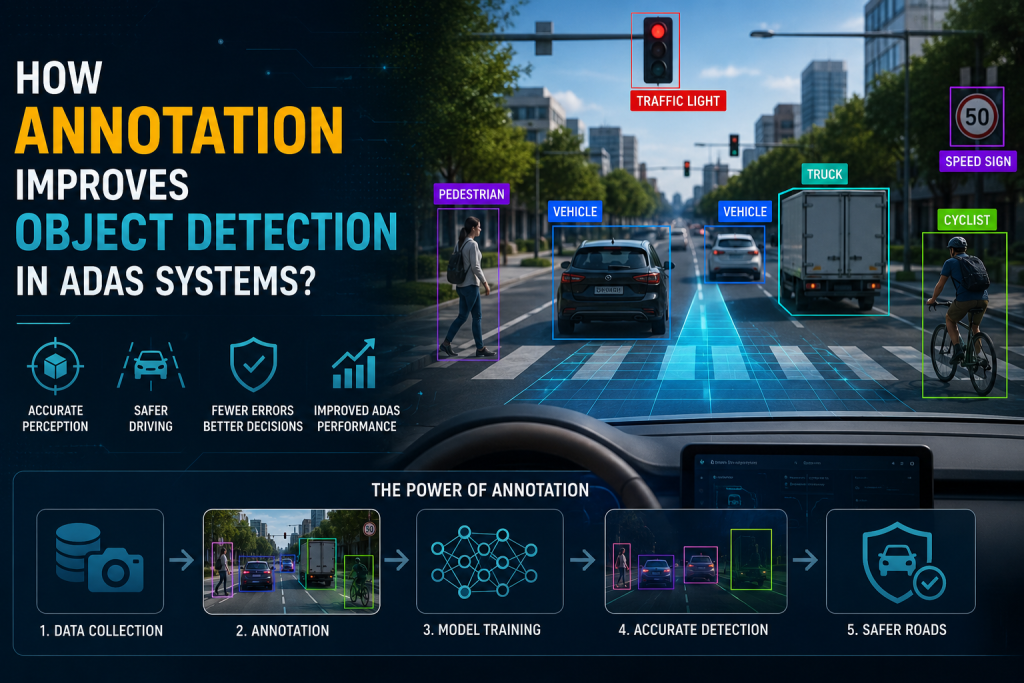
How Annotation Improves Object Detection in ADAS Systems?

Advanced driver assistance systems (ADAS) are a revolution in automobiles that offer improvements in safety, error reduction from human factors, as well as semi-autonomous driving. But at the heart of these intelligent systems is a single crucial component: high-quality data annotation. Correct annotation directly influences the reliability of ADAS model object recognition, e.g. pedestrian, vehicles, lane marking, traffic sign etc., and reaction to the objects. What is Object Detection in ADAS? In the context of ADAS, object detection is the process of identifying, categorizing, and tracking objects in real time using data from cameras, LiDAR, radar, and other sensors and AI models. They supply energy for functions such as: Role of Annotation for ADAS Annotation involves human input of raw data from sensors to label the data, which takes it one step closer to the machine learning models able to learn patterns and make decisions. Even the best AI models will fail to perform well without accurate annotation. Different Types of Annotation for ADAS Applications 1. Bounding Box Annotation Can be used to detect cars, pedestrians, cyclists and animals. Impact: Assists users in finding and categorising quickly multiple objects in real time. 2. Semantic Segmentation Annotates each image pixel in an image (road, sidewalk, vehicle, sky, etc.). Impact: Allows for accurate scene understanding and road detectability. 3. Instance Segmentation Discerns and discriminates between two or more similar from a class. Impact: Important for dispatching several cars and/or persons. 4. Polygon Annotation Maintains the ability to capture shapes which are not regular such as lane markings and the road boundary. Impact: Better Lane Detection and Road Edge Recognition. 5. Keypoint Annotation Indicates locations like corners of vehicles or pedestrian crossings. Impact: Useful for motion prediction and behavior analysis. 6. LiDAR (3D) Annotation Labels 3D data point clouds for depth and spatial awareness. Impact: Enhances distance estimation and collision avoidance. How Annotation Improves Object Detection? 1. Increases Model Accuracy Annotated data enables AI models to develop proper object boundaries, shape, and classification. 2. Enhances Real-Time Decision Making Improved labelling facilitates rapid detection and action, essential in safety-critical situations. 3. Reduces False Positives and Negatives Good annotation helps to reduce errors such as: 4. Enhances Edge Case Performance Models are made more robust when they are trained on annotated datasets which have a wide variety of scenarios (rain, fog, night driving etc.). 5. Allows Improved Sensor Fusion Overall consistent annotation of the camera, LiDAR and radar data aids in multi-sensor integration. Importance of High-Quality Annotation All annotation is not created equal. Labeling can sometimes be quite poor, causing nasty results in an ADAS system. Key Quality Factors: Challenges in ADAS Annotation Best Practices for ADAS Annotation Real-World Impact ADAS systems can be, with the help of high quality annotation: Conclusion For effective object detection in ADAS systems, the bases are annotations. Labelled data directly impacts the vehicle’s ability to correctly and safely understand the world around it. Investing in high-quality annotation is not just a technical necessity—it’s a critical step toward building safer roads and more reliable autonomous driving systems.

data annotation services, human-in-the-loop

Manual vs Automated Data Annotation: Pros, Cons, and Use Cases

Data annotation is essential for training AI models, but one big question organizations face is: Is it better to use humans, automation or both? This question is dependent on the complexity of your project, level of accuracy, budget, and schedule. This knowledge allows you to design the correct workflow by knowing all the weaknesses and limitations of manual and automated annotation. What is Manual Data Annotation? Human annotators do the manual annotation whereby the data are assigned labels according to guidelines and domain knowledge. It is the classical method and is crucial in cases of high accuracy AI systems.  Pros of Manual Annotation Cons of Manual Annotation Best Use Cases  What Is Automated Data Annotation? Automated data annotation involves the pre-labeling, or fully labeling of data with little human assistance or AI models, scripts, or tools. Pros of Automated Annotation  Cons of Automated Annotation Best Use Cases (Best of Both Worlds): The Hybrid Approach. Certainly, the costs of today AI pipelines are comprised of a combination of both approaches: Speed is processed by automation → Accuracy of humankind. Workflow example: This saves money and time as well as preserving quality. Comparison at a Glance Factor Manual Annotation Automated Annotation Speed Slow-Moderate Very fast Cost Higher Lower Accuracy High (complex tasks) Moderate Scalability Limited by workforce Highly scalable Edge Case Handling Strong Weak Best For Complex, domain-specific data High-volume, repetitive data How to Choose the Right Approach? Ask these questions: Final Thoughts Annotation is increased with automation. Humans make it reliable. Instead of this, the most successful AI teams do not work with either but set up AI-assisted human-in-the-loop pipelines that strike the optimal equilibrium between efficiency and precision.

Scroll to Top