
keypoint annotation

data annotation services, keypoint annotation

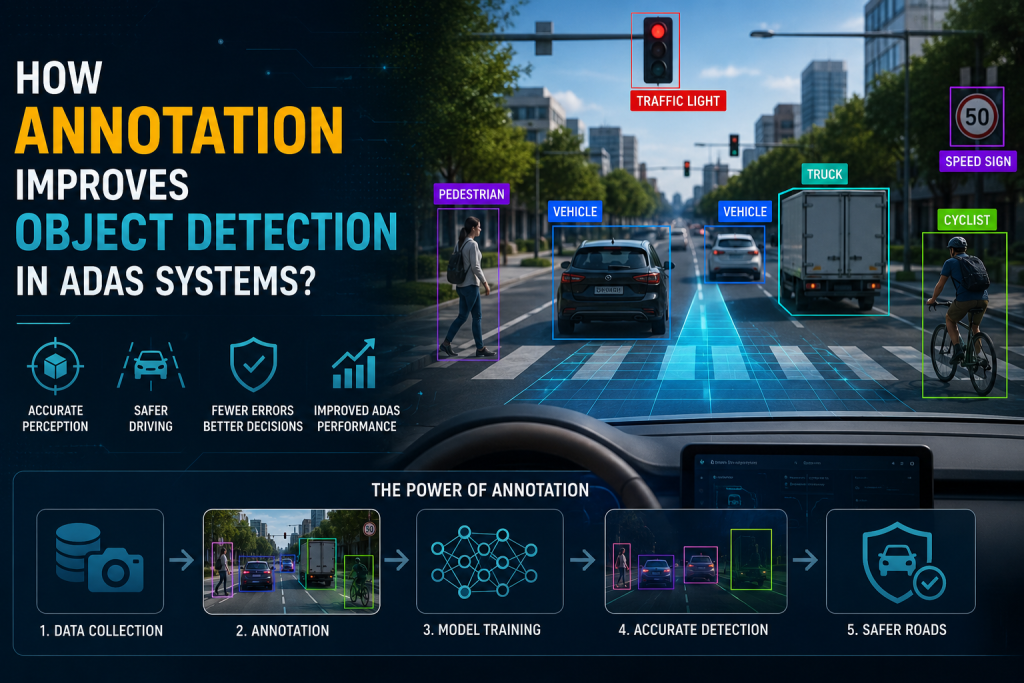
How Annotation Improves Object Detection in ADAS Systems?

Advanced driver assistance systems (ADAS) are a revolution in automobiles that offer improvements in safety, error reduction from human factors, as well as semi-autonomous driving. But at the heart of these intelligent systems is a single crucial component: high-quality data annotation. Correct annotation directly influences the reliability of ADAS model object recognition, e.g. pedestrian, vehicles, lane marking, traffic sign etc., and reaction to the objects. What is Object Detection in ADAS? In the context of ADAS, object detection is the process of identifying, categorizing, and tracking objects in real time using data from cameras, LiDAR, radar, and other sensors and AI models. They supply energy for functions such as: Role of Annotation for ADAS Annotation involves human input of raw data from sensors to label the data, which takes it one step closer to the machine learning models able to learn patterns and make decisions. Even the best AI models will fail to perform well without accurate annotation. Different Types of Annotation for ADAS Applications 1. Bounding Box Annotation Can be used to detect cars, pedestrians, cyclists and animals. Impact: Assists users in finding and categorising quickly multiple objects in real time. 2. Semantic Segmentation Annotates each image pixel in an image (road, sidewalk, vehicle, sky, etc.). Impact: Allows for accurate scene understanding and road detectability. 3. Instance Segmentation Discerns and discriminates between two or more similar from a class. Impact: Important for dispatching several cars and/or persons. 4. Polygon Annotation Maintains the ability to capture shapes which are not regular such as lane markings and the road boundary. Impact: Better Lane Detection and Road Edge Recognition. 5. Keypoint Annotation Indicates locations like corners of vehicles or pedestrian crossings. Impact: Useful for motion prediction and behavior analysis. 6. LiDAR (3D) Annotation Labels 3D data point clouds for depth and spatial awareness. Impact: Enhances distance estimation and collision avoidance. How Annotation Improves Object Detection? 1. Increases Model Accuracy Annotated data enables AI models to develop proper object boundaries, shape, and classification. 2. Enhances Real-Time Decision Making Improved labelling facilitates rapid detection and action, essential in safety-critical situations. 3. Reduces False Positives and Negatives Good annotation helps to reduce errors such as: 4. Enhances Edge Case Performance Models are made more robust when they are trained on annotated datasets which have a wide variety of scenarios (rain, fog, night driving etc.). 5. Allows Improved Sensor Fusion Overall consistent annotation of the camera, LiDAR and radar data aids in multi-sensor integration. Importance of High-Quality Annotation All annotation is not created equal. Labeling can sometimes be quite poor, causing nasty results in an ADAS system. Key Quality Factors: Challenges in ADAS Annotation Best Practices for ADAS Annotation Real-World Impact ADAS systems can be, with the help of high quality annotation: Conclusion For effective object detection in ADAS systems, the bases are annotations. Labelled data directly impacts the vehicle’s ability to correctly and safely understand the world around it. Investing in high-quality annotation is not just a technical necessity—it’s a critical step toward building safer roads and more reliable autonomous driving systems.

keypoint annotation

How Keypoint Annotation is Empowering Advancements in Robotics?

Keypoint annotation also helps in the evolution of increased surveys for robotics platforms due to the enhancement of Robotic perception, manipulation as well as interaction in between robots and the environment. Here are several ways keypoint annotation is empowering advancements in robotics: 1. Enhanced Perception and Object Recognition Accurate Object Identification: Keypoint annotation also permits establishment of visions of objects in the environment and their identification based on the labelling of certain points on these objects. This is especially important for such procedures as object recognition, as the existing robotic systems have to know not only the definite object but also its position and orientation. 3D Reconstruction: When how objects are approached touching is considered, it is thus possible to conclude that robots can recreate the three dimensional shape of objects on silhouettes. Understanding of such a three-dimensional environment is essential to robot orientation and desire to move within the setting efficiently and safely. 2. Improved Human-Robot Interaction Pose Estimation: As for human pose estimation, the current practice is to annotate as many keypoints as possible this facilitates the robots to understand the regular and predict the future actions of humans. This is particularly important when applied on robots that work side by side with human staff to avoid causing harm to personnel while at the same time ensuring that productivity is at its highest. Gesture Recognition: The interpretation of the concept of annotating keypoints is understandable in the following way: The meaning of the notes is to make robots understand human gestures better since simple movements can be performed using peaks and valleys at their best. This is of great help especially in the smart assistive devices & Robots and also in the service robots. 3. Advanced Manipulation and Grasping Dexterous Manipulation: Keypoints on objects can be helpful to robots in choosing the best actions for various manipulations to be performed and in recognizing objects as well as in manipulating them. This is specifically so in industrial enabling applications to reduce error variability because of the need to control devices and automate production lines. Adaptive Grasping: Keypoints of an object can be used to adapt the approach for picking up different objects by making different adjustments, because the efficiency of the approach is independent from the type of the gripper which is no more needed to be very specific for different types of the objects. 4. Autonomous Navigation Scene Understanding: Keypoint annotations are useful for improving scene understanding as certain main reception points and peculiar elements of the environment, which should be taken into consideration, are emphasized. This aids in the robot’s search for it through unfamiliar or shifting routes, in a better and more efficient way. Obstacle Avoidance: Annotated keypoints enable and determine exact location of and otherwise powerful and efficient path for obstacles that are identified by robots. This is useful for self-driving cars as well as delivery robots that operate in both dense and dynamic environments. 5. Training and Simulation Data-Driven Learning: These annotated keypoints make it possible to attain high quality training data for the learning models applied in robotics and demonstrate high efficiency for the algorithms used in this field. It would be crucial for training the models that we can take up in tasks like object recognition, pose estimation, and manipulation. Simulation Environments: Keypoints can be employed in the creation of believable environment scenarios for the training and evaluation of mobile robots in simulations. It has the benefit of aiding the development of robotic algorithms and systems to a point where they are ready for use in practical settings. 6. Medical and Assistive Robotics Surgical Precision: In medical robotics, the keypoint annotation is particularly useful in the definition of the anatomical points to assure high performance of surgical patient’s robots. Rehabilitation: It is incorporated that, the assistive robots often applies the keypoint annotations for the tracking of patients; exercises provision; and even the progression over a period of time. Conclusion The task of keypoint annotation is one of the important key technologies for robotics that contribute to the development of the domain considerably. Based on the knowledge and understanding of environments as well as the ability of robots to recognize places, keypoint annotation improves the functionalities of robotic systems, which in turn results in advanced, reliable, and human-friendly robotic systems. This is creating new areas of development and opportunities for improvement in robotics used in various domains, including manufacturing, production, healthcare, transportation, and home management. If you wish to learn more about Annotation Support’s data annotation services,please contact our experts at https://www.annotationsupport.com/contactus.php

Scroll to Top