
Humans have more to rely on experience and some labeling spiritually than autonomous vehicles, which need huge quantities of labeled data to comprehend everything around them. The two crucial data types applied in training such systems are LiDAR and image data. Both are vital, but have different functions along with carrying various benefits and difficulties.
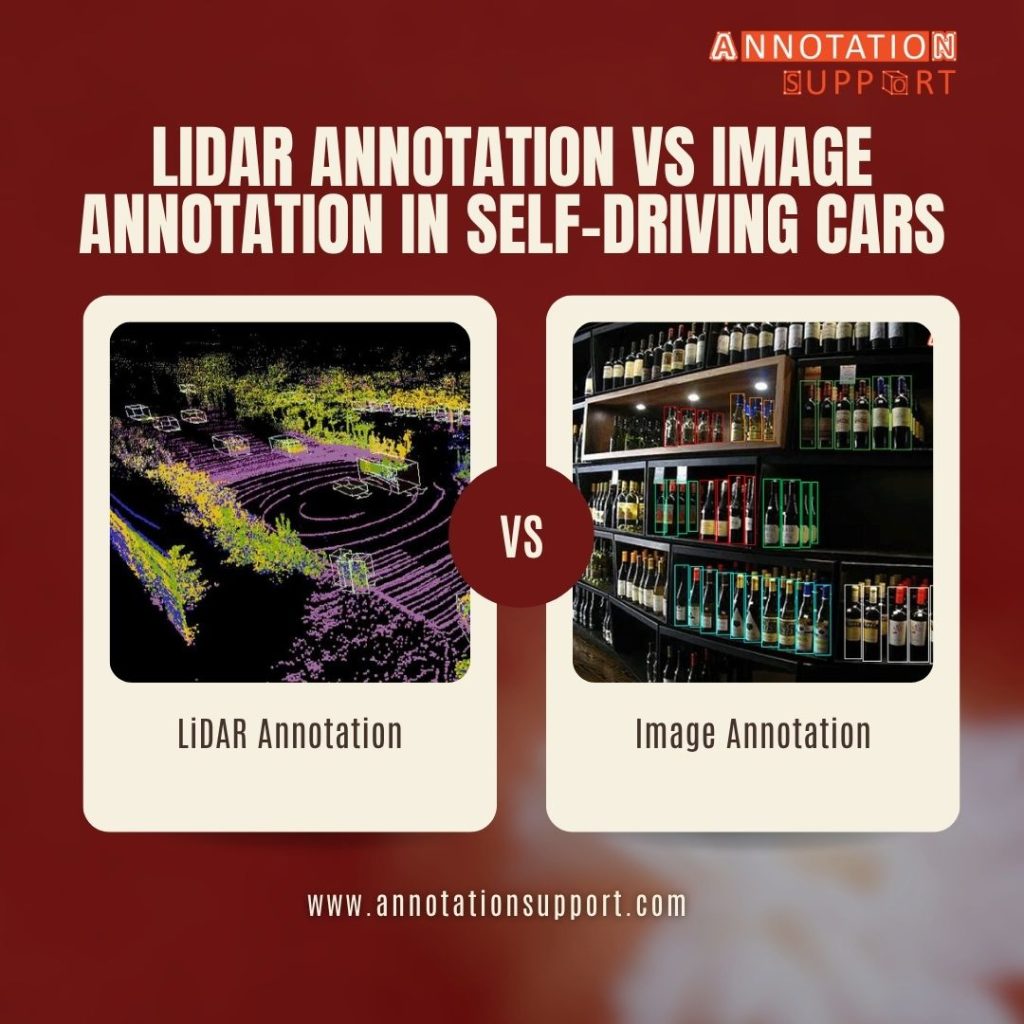
What is LiDAR Annotation?
LiDAR annotation is the process of tagging 3D point cloud data collected with LiDAR sensor. These sensors produced laser pulses and then calculated the time elapsed between the pulse being sent and the pulse returning in order to develop an elaborate 3D image of the surrounding area.
Key Features of LiDAR Annotation
- Supports 3D point cloud working
- Presents accuracy in depth and distance
- Produces accurate locating of objects
- Naturally performs well in low light settings
Common LiDAR Annotation Techniques:
- 3D Bounding Boxes
- Cuboid Annotation
- Semantic Segmentation (3D)
- Point-wise Classification
What is Image Annotation?
Labeling 2D visual data acquired from cameras is known as Image annotation. This refers to identification of objects, lane marks, pedestrians, traffic sign and among the others.
Key Features of Image Annotation:
- Deals with two-dimensional pictures
- Shows color, texture, and visual detail.
- More convenient and less expensive
- Commonly employed in Computer Vision applications
Common Image Annotation Techniques:
- Bounding Boxes
- Polygon Annotation
- Semantic Segmentation (2D)
- Keypoint Annotation
Key Differences: LiDAR vs Image Annotation
| Feature | LiDAR Annotation | Image Annotation |
| Data Type | 3D Point Cloud | 2D Images |
| Depth Perception | High accuracy | Limited (requires estimation) |
| Lighting Conditions | Works in low light/night | Affected by lighting |
| Detail Level | Less texture detail | Rich visual detail |
| Cost | Expensive | More affordable |
| Complexity | High (requires expertise) | Moderate |
| Use Cases | Distance measurement, object tracking | Object recognition, classification |
Advantages of LiDAR Annotation
- Excellent sense of distance and space
- Better for detecting objects in challenging areas
- Steady under night/dark weather conditions
- Crucial for mapping and navigation in 3D
Advantages of Image Annotation
- Availability of rich visual context (colour, signs, signals)
- Reduced labelling expenses and quicker turnaround
- Possibility of scaling larger data sets easier.
- Perfect solution for classification and recognition applications.
Challenges in LiDAR Annotation
- Cost of LiDAR (as sensors and data processing are expensive)
- Advanced annotation features and processes
- Requires skilled professionals
- Large data volumes
Challenges in Image Annotation
- Low light performance issues
- Limited depth perception
- Easily affected by environmental factors (fog, rain, glare)
- May need more than one camera angle to be accurate
In what way do Autonomous Vehicles use Both?
Self-driving systems are not actually relying on 1 data type alone but using several types (sensor fusion) to enhance the accuracy and safety.
Sensor Fusion Benefits:
- Combines LiDAR’s depth accuracy with camera’s visual richness
- Enhances identification and categorization of objects
- Taken into account for real time decision making.
- Minimizes faulty driving conditions (in complex driving situations).
Use cases on self-driving cars
LiDAR Annotation is best for:
- 3D object detection
- Collision avoidance
- Mapping and localization
Image Annotation is best for:
- Traffic sign recognition
- Lane detection
- Pedestrian & vehicle classification
What is the best choice?
Truthfully it is this: it’s not about just one.
- For applications needing to save on depth and spatial accuracy use LiDAR annotation
- When a visual context and classification is required, use image annotation.
- The optimum result is to have both on board applying sensor fusion methods
Conclusion
LiDAR and Image annotation are key foundations of self-driving technology. LiDAR offers unparalleled spatial accuracy, and image annotation offers rich visual understanding. These combine to create safer smart and reliable self driving.