
Advanced driver assistance systems (ADAS) are a revolution in automobiles that offer improvements in safety, error reduction from human factors, as well as semi-autonomous driving. But at the heart of these intelligent systems is a single crucial component: high-quality data annotation.
Correct annotation directly influences the reliability of ADAS model object recognition, e.g. pedestrian, vehicles, lane marking, traffic sign etc., and reaction to the objects.
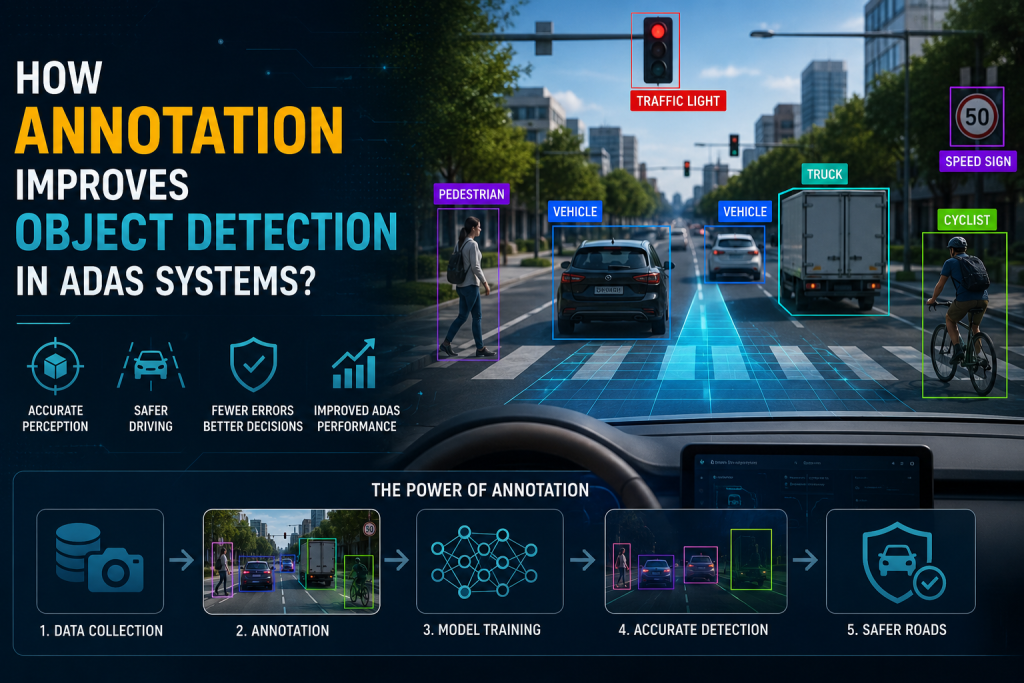
What is Object Detection in ADAS?
In the context of ADAS, object detection is the process of identifying, categorizing, and tracking objects in real time using data from cameras, LiDAR, radar, and other sensors and AI models.
They supply energy for functions such as:
- Collision avoidance
- Lane departure warning
- Adaptive cruise control
- Pedestrian detection
- Traffic sign recognition
Role of Annotation for ADAS
Annotation involves human input of raw data from sensors to label the data, which takes it one step closer to the machine learning models able to learn patterns and make decisions.
Even the best AI models will fail to perform well without accurate annotation.
Different Types of Annotation for ADAS Applications
1. Bounding Box Annotation
Can be used to detect cars, pedestrians, cyclists and animals.
Impact: Assists users in finding and categorising quickly multiple objects in real time.
Annotates each image pixel in an image (road, sidewalk, vehicle, sky, etc.).
Impact: Allows for accurate scene understanding and road detectability.
Discerns and discriminates between two or more similar from a class.
Impact: Important for dispatching several cars and/or persons.
4. Polygon Annotation
Maintains the ability to capture shapes which are not regular such as lane markings and the road boundary.
Impact: Better Lane Detection and Road Edge Recognition.
Indicates locations like corners of vehicles or pedestrian crossings.
Impact: Useful for motion prediction and behavior analysis.
6. LiDAR (3D) Annotation
Labels 3D data point clouds for depth and spatial awareness.
Impact: Enhances distance estimation and collision avoidance.
How Annotation Improves Object Detection?
1. Increases Model Accuracy
Annotated data enables AI models to develop proper object boundaries, shape, and classification.
2. Enhances Real-Time Decision Making
Improved labelling facilitates rapid detection and action, essential in safety-critical situations.
3. Reduces False Positives and Negatives
Good annotation helps to reduce errors such as:
- Misidentifying objects
- Missing critical obstacles
4. Enhances Edge Case Performance
Models are made more robust when they are trained on annotated datasets which have a wide variety of scenarios (rain, fog, night driving etc.).
5. Allows Improved Sensor Fusion
Overall consistent annotation of the camera, LiDAR and radar data aids in multi-sensor integration.
Importance of High-Quality Annotation
All annotation is not created equal. Labeling can sometimes be quite poor, causing nasty results in an ADAS system.
Key Quality Factors:
- Accuracy and precision
- Consistency across datasets
- Adoption of common procedures and protocols
- Multi-level quality checks
- Domain expertise
Challenges in ADAS Annotation
- Large volumes of data
- Complex urban environments
- Requires accuracy when dealing with real time.
- The labor costs of making manual annotations are too high.
- Addressing rare cases, typical situations (edge cases)
Best Practices for ADAS Annotation
- Utilize trained annotation experts.
- Use AI-powered annotations features.
- Strict adherence to QA process.
- Iteratively add more scenarios to datasets
- Make that there is scalability and consistency
Real-World Impact
ADAS systems can be, with the help of high quality annotation:
- More accurately locate pedestrians
- Prevent crash collisions in challenging traffic situations
- Keep lane correctly positioned
- Identify traffic signs at a glance
- Drive the general increases in driving safety
Conclusion
For effective object detection in ADAS systems, the bases are annotations. Labelled data directly impacts the vehicle’s ability to correctly and safely understand the world around it. Investing in high-quality annotation is not just a technical necessity—it’s a critical step toward building safer roads and more reliable autonomous driving systems.