data annotation services

annotation company, data annotation services

The Secret Revealed: Quality Control Techniques Used by Annotation Support in Data Annotation Projects

Ensuring high-quality annotated data is the backbone of any successful AI or machine learning system. But maintaining accuracy at scale is not easy—especially when projects involve thousands (or millions) of data points. This is where Annotation Support, a trusted data annotation partner, stands apart. This article unveils quality control (QC) methods that Annotation Support applies to provide stable, dependable, or production-quality datasets. Why Quality Control is Important in Data Annotation? The quality of the data used to train AI models is very important. The incorrectly annotated data sets result in: The Annotation Support makes sure none of these problems happen because it is a multi-layered QC approach which makes sure that every step is precise. 1. Multi-Level Review System (3-Tier QC Process) Annotation Support follows a three-tier quality check in order to eradicate errors: Level 1: Annotator Self-Check Cross-validation Annotators use checklists and platform validation to check the annotations made by them. Level 2: Peer Review The second trained annotator checks the batch that was completed against consistency, edge cases and guidelines. Level 3: Expert Quality Assurance. Final audit by senior QA specialists is done to establish the accuracy of the dataset within the benchmarks required by the clients (which is often 95-99%). This multi-layered system will reduce the number of human errors and only quality data will proceed. 2. Standardized Annotation Guidelines Annotation Support develops before an initiative is initiated: Standardization makes the interpretation of the annotation clear and all annotators understand the work with an identical interpretation and this helps to increase accuracy and consistency. 3. Automated Error Detection Tools Annotation Support will use automation tools to accelerate the QC and minimize human errors: These aid in identifying mistakes at an early stage and improve the review process 4. Gold Standard Data Benchmarking Annotation Support has so-called golden datasets which are expert-labeled samples that serve as a point of reference. The annotators will be required to compare their results with these gold standards. Any significant shift in the deviation reveals the incompleteness of the knowledge and leads to further training. 5. Training & Skill Development Programs Annotation Support spends heavily on the development of the skill of the annotator: This constant improvement keeps the annotators abreast with the developments and gives them perfect results. 6. Continuous Feedback Loops QA teams have a feedback connection with annotators: This instills a learning and innovation culture. 7. Collaboration with clients and Refinement Annotation Support collaborates with the clients to perfect: This makes the dataset adapt to the changes in the project requirements. Why Companies Trust Annotation Support? Annotation Support has credited its reputation on: Based on these processes, Annotation Support becomes a desirable collaborator of any AI-driven organization in any industry. Final Thoughts It is not much of a secret that high-quality annotation is achievable – but keeping it at a high level when dealing with large volumes of data is. Annotation Support attains this by an advanced combination of: Through these methods, Annotation Support makes all datasets correct, consistent, and prepared to make the world-class AI and ML work.

annotation company, autonomous vehicles, data annotation services

Why “Annotation Support” Stands Among the Top Data Annotation Companies Globally?

“Annotation Support” has won a notable place among global data annotation providers by always delivering high-quality, flexible, and adjustable solutions. Let’s look at the reasons it separates itself from the other top companies in the industry. 1. Industry-Specific Expertise “Annotation Support” covers in-depth information in many different industries. As a result, clients can expect data that addresses their industries in particular. 2. Wide Range of Annotation Services From the basic step of rendering as 2D boxes to following the movement of 3D objects, “Annotation Support” handles many types of object detection. The wide range of services attracts clients from all kinds of AI training industries. 3. Quality-Driven Process “Annotation Support” has these features: For models to succeed, accuracy and consistency need to be found in its services. 4. Scalable Workforce and Tools No matter if it is a small startup or a big enterprise, “Annotation Support” can match the needs of any organization. As a result, different projects will benefit from flexibility and lower costs. 5. Secure and Confidential Operations Ensuring security is very important in such projects. “Annotation Support” brings the following benefits: For this reason, our services matter most to companies in healthcare, fintech, and legal tech. 6. Global Clientele and Proven Track Record “Annotation Support” has: Global reach and a strong track record reinforce its credibility. 7. Innovation and Customization It allows data to be labelled with a goal of improving AI in the future. That’s why “Annotation Support” is notable; it gathers domain expertise, looks after technological aspects, tests rigorously for quality, addresses security matters, and delivers results internationally. Because of these strengths, companies prefer to use it when developing dependable, error-free, and expandable AI systems.

data annotation services

Maximizing AI Performance through Effective Data Annotation Services

Maximizing the performance of Artificial Intelligence (AI) systems hinges on the quality of the data used for training and validation. Effective data annotation services play a critical role in ensuring that AI models are trained on precise, relevant, and contextually accurate data, which directly influences their accuracy, reliability, and usability. Below is an in-depth exploration of how effective data annotation services enhance AI performance: 1. The Significance of High-Quality Data Annotation. For supervised learning, AI models, and more specifically machine learning (ML) and deep learning trained AI models, rely on labelled datasets. Accurate annotations ensure that: 2. Types of Data Annotation Annotation needs to be effective which means covering different data formats such as text, images, video, and audio. Common annotation types include: For Text: Sentiment Annotation: Sentiment labels for text data labelled as positive, neutral, or negative. Entity Recognition: Named Entity Recognition – tagging entities with names, locations, dates or products. Intent Annotation: Inferring the intent in user queries that are necessary for chatbots and voice assistants. For Images: Bounding Boxes: Facilitating object detections by drawing boxes around the objects. Semantic Segmentation: Precise pixel labelling of an image for understanding. Image Classification: Categorizing entire images. For Video: Frame-by-Frame Labelling: Incorporating actions, objects or events in a video sequence. Activity Recognition: Computing patterns of movement or behaviour. For Audio: Speech-to-Text: Writing text from spoken words. Speaker Identification: Different speakers labelling in audio data. Event Detection: Labelling what sounds or events are, for example, alarms or sirens. 3. Improving AI Performance through Data Annotation A. Improved Model Accuracy B. Contextual Understanding The data are annotated according to domain-specific knowledge by annotators who are aware of this knowledge, contributing to contextual relevance of the data that enables AI to perform complicated applications out of its box. C. Reduced Bias Balanced and diverse annotations help mitigate biases in the training data, ensuring fair and equitable AI performance. D. Accelerated Training With well annotated data your model trains faster because there is not as much time spent in repeated iterations looking for performance that is not as good as your model should be. 4. Best Practices for Effective Data Annotation To maximize the benefits of data annotation, the following practices are essential: 5. Outsourcing vs. In-House Annotation Outsourcing: With professional data annotation services, you will have access to experienced annotators, quality assurance processes, and scalability. In-House: It is good for sensitive or domain specific projects, but at the cost of very big resources and expertise. Conclusion Foundation to the success of AI systems are effective data annotation services. Investing in good quality, scalable and context aware annotation processes enable organizations to realize the full potential of their AI solutions with higher accuracy, reliability and applications.

data annotation services

An In-Depth Look at Different Types of Data Annotation Services

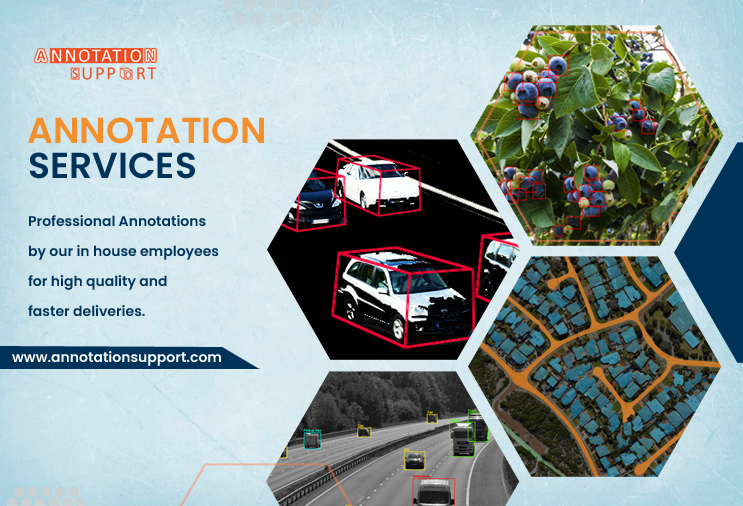
If machine learning and artificial intelligence models need to learn patterns and make predictions, then they need data annotation services to get their data present in a manner they understand. There are different kinds of data annotation services available that serve different applications, and they have different characteristics, as well as their own methods of conduct. Here’s an in-depth look at the main types of data annotation services support particular machine learning and AI tasks. 1. Image and Video Annotation Bounding Boxes: Bounding boxes are rectangles, drawn around objects to tell where they are. In applications such as autonomous driving and security surveillance, where objects must be located (cars or people), this is a natural method of approach. Polygon Annotation: Irregularly shaped objects that won’t fit in a rectangle are best suited to polygon annotation. Applications where boundary detection is of paramount importance, including medical imaging and autonomous drones, use this method. Semantic Segmentation: That’s simply labelling each pixel in the image on it with a class label (e.g. “road”, “vehicle” or “pedestrian”). Pixel level accuracy is required in the field, such as in autonomous driving and environmental monitoring, where semantic segmentation is very popular. Instance Segmentation: Instance segmentation is different from semantic segmentation in the fact that instance segmentation labels each instance of the same class, while semantic segmentation labels only the class. At the same time, it’s important because many applications want to distinguish between the same object, like how you might count individual trees or animals. Video Annotation: For the video data, annotations are done frame level wise indicating the movement and time changes. In action recognition, motion tracking, and behavior analysis, this is useful, applications include sports, surveillance, and robotics. 2. Text Annotation Named Entity Recognition (NER): Entities are the things that make up text (NAMES, ORGANISATIONS, DATES, etc) and NER identifies and categorizes them. This is very useful in natural language processing (NLP) like sentiment analysis, customers support and information retrieval. Sentiment Annotation: In sentiment annotation, one tags text containing emotional tone (positive, neutral, negative). This type is very commonly used for social media monitoring, customer feedback analysis and brand reputation management. Linguistic Annotation: Such includes syntax, grammar, as well as part of speech tagging. These annotations help the language models and chatbots understand how the sentences are structured and what might be the context behind it. Entity Linking: From NER, Entity linking goes further by linking to a DB or a knowledge graph. The most exciting application of CF is to improve the relevance of the retrieved information in recommendation systems, search engines, answer question systems, etc. 3. Audio Annotation Speech Recognition Annotation: In speech recognition, a model is trained in conversing audio to text where transcriptions of spoken language are produced and provided. But much of the use comes from in virtual assistants, transcription services and automated customer support. Speaker Identification and Diarization: Speaker identification tags specific speakers to an audio file while the diarization marker is a section of audio for which a specific speaker is tagged. In multi speaker environments like meetings, call centres and voice authentication, these annotations are crucial. Sentiment and Intent Annotation: And we have these annotations that tell you what the tone or intent of the spoken words are — this is very important for conversational AI and customer service analytics. Audio Classification and Tagging: The sounds are labelled with category (e.g. ‘laughter’, ‘applause’, ‘alarm’) in training to models that have applications in security, entertainment, and environmental monitoring. 4. 3D Point Cloud Annotation 3D Bounding Boxes: Like in 2D bounding boxes, 3D bounding boxes are objects that encapsulate 3D objects. Object detection in LiDAR data is an indispensable form of annotation in autonomous driving. Semantic and Instance Segmentation: This is point cloud data segmentation, which adds labels to individual points in a 3D space – based on what they are, e.g. an object – making it perfect for identifying particular structures in very complex environments, like urban planning or even construction. Trajectory and Path Annotation: Annotation in this sense is about tracking an object’s movement through a 3D space over time. In robotics and drone navigation for example, understanding movement paths is required and commonplace. 5. Human Activity Recognition (HAR) Annotation Pose Estimation: Key body parts (for example arms, legs and head) are labelled to describe body posture in pose estimation annotations. The fitness, motion analysis and healthcare applications utilize this annotation type. Behavioral labelling: Classifying things like licking, walking, running, sitting, or fetching the cat is what models can do when human activities are annotated. Sports analysis, smart home applications, elderly care monitoring, or other things are the things this is commonly used for. Sequential Frame labelling: Each frame of videos is labelled to monitor the continuous activities in time. Applications in security, retail and in behavioural research can make use of it. Conclusion Different data annotation types solve different needs for particular purposes, thus the need to choose a type of data annotation appropriate to the use case of your application. However, high quality data annotation services for these types of data enable us to accurately and efficiently train machine learning and AI models and move our technology forward in domains like computer vision, NLP and autonomous systems. Interested to get high quality and data secured annotation services ,contact us at https://www.annotationsupport.com/contactus.php

data annotation services

Data Annotation Services: The Backbone of Self-Driving Cars and Their Impact on the Future of Mobility

Autonomous vehicles, one of the revolutionary technologies in the contemporary world, are set to drastically transform transportation. Deep at the center of these self-driving car(s) is an artificial intelligence engine which relies greatly on large datasets that are tagged correctly. Self-driving car systems necessarily require data annotation services, which refer to the process of labelling data. By enabling vehicles to understand and interpret their surroundings, data annotation has emerged as the backbone of autonomous driving technology. The Role of Data Annotation in Autonomous Vehicles Perception in self-driving cars is achieved through various systems such as cameras, LiDAR – Light Detection and Ranging, radar and ultrasonic systems. These sensors produce a huge volume of raw data, which should be correctly analysed by AI of the vehicle to make necessary immediate decisions at the moment, including the detection of the obstacles on the way, recognition of traffic signs, and the forecast of the actions of the pedestrians on the crossroad.  Data annotation services enable this process by providing the following key capabilities: Object Detection and Classification: They identify objects that are present in images and videos collected by the vehicle’s vision systems; these include but are not limited to; pedestrians, traffic signs, and other cars. It enables the AI system to effectively identify, categorise and then interact with an object in real time. Semantic Segmentation: This means assigning each pixel of an image with a particular category (e. g., road, sidewalk, vehicle, etc.) so that it can be able to distinguish the various features of the surroundings accurately. Semantic segmentation is important for such tasks as lane detection and avoidance of the obstacles on the road.  Bounding Box and Polygon Annotation: The definition of the shape and position of objects in the image use bounding boxes and polygon. They assist the self-driving cars to estimate the scale and position of the objects in 3D space.  3D Point Cloud Annotation: LiDAR provides a point cloud that is a three-dimensional model of the environment, providing perceptive depth to self-driving cars. Annotators assist in the tagging of this 3D information enabling the vehicle to establish depth and object tracking in real-time as this is imperative for successful navigation in them.  Tracking and Predictive Behaviour Annotation: Vehicles have to navigate through environments that are dynamic that is why it cannot only detect objects, but rather predict their dynamics. By annotating movement trajectories of vehicles, pedestrians, and cyclists, artificial intelligence has a better understanding of the planning behaviour that follows and a better chance at making good decisions for safety’s sake.  Impact of Data Annotation on Autonomous Vehicle Development The quality of annotated data is decisive for the function of the self-driving systems. High quality annotations, which include the checking and validation, make certain that the AI models are able to perform well under various scenario such as different road terrains, weather circumstances and in the urban or rural settings. Some of the ways in which data annotation services are driving advancements in self-driving cars include: Enhanced Safety: Annotation services also contribute to the quality of labelled data, to have a better perception of possible risks that AI will decide and act upon. This is regarded crucial in avoidance of cases of accidents and achieving better control of traffic in areas of high traffic density. Accelerated AI Training: Teaching machines to learn as humans learn with perception intelligence necessitates a big data with carefully annotated data. Annotation services facilitate this process by generating high volumes of labelled data to support further machine learning optimization. Adaptability across Geographies: Self driving vehicles need to be able to respond to traffic signs, signals and other traffic conditions existing globally. Data annotation services provide region-specific data that locates AI systems by identifying particular nation’s attributes like traffic signs or road markings. Real-World Simulations and Testing: To build such environment replicas as well as to perform simulations self-driving algorithms require annotated data. Such tests can be performed in a safer way in such conditions as sudden movements from the pedestrians or adverse weather conditions. Challenges in Data Annotation for Self-Driving Cars Despite its critical role, data annotation for autonomous vehicles faces several challenges: Scale and Complexity: Automated cars produce large volumes of data daily, not least during road trials. Manual annotation of this data at scale, specifically, for datasets such as LiDAR point clouds, can be highly time and resource-consuming and require skilled personnel. Accuracy and Consistency: Hence it important to ensure that the annotations are correct and consistent since any mistake in the labelling process may lead to a wrong AI decision that may compromise on the safety of the vehicle. Edge Cases: Some of the most difficult situations to annotate are: labelling paths that are seldom applied (for example, animals on the road, linked and rapid movements of pedestrians). These situations must be distinctively incorporated into training data to have an assurance that vehicles will respond to the irregularities. Time and Cost: Manual annotation, particularly of 3D and video data, may be expensive and time consuming and hence may not be a feasible option. The requirement to strike a fine line between high quality annotations and speed is still a difficulty for autonomous vehicle organizations. The Future of Mobility and Data Annotation Year by year, self-driving technology remains to be a key aspect in developing autonomous vehicles, and the job of data annotation is an important part of this process. In the future, improvements in AI based annotation tools and methods of active learning could alleviate and decrease the dependency of manual labelling making this process cheaper and faster. Moreover, as the presence of self-driving cars increases in the future to become an integral part of transportation networks, data annotation services would require broader to encompass novel mobility that will be developed, including drone delivery networks and self-driving public transit systems. As mobility goes more toward fully automated systems, acquiring techniques to label progressively complicated data sets will be crucial. Conclusion Self-driving car revolution is incomplete without data annotation

Scroll to Top