Case Studies
- Supporting Universities and Research Institutes in USA, Denmark and UAE for their AI researches through our Annotation services
- Polygon annotations to AI companies in Sweden, Singapore and USA
- Point cloud / 3D LiDAR annotations to AI companies in USA, Germany and Japan
- How Annotation Support Helped a Recycling Company Improve Waste Sorting Accuracy?
- Annotation support to a Research Institution to improve people mobility
- Annotation services to an Aqua culture farm
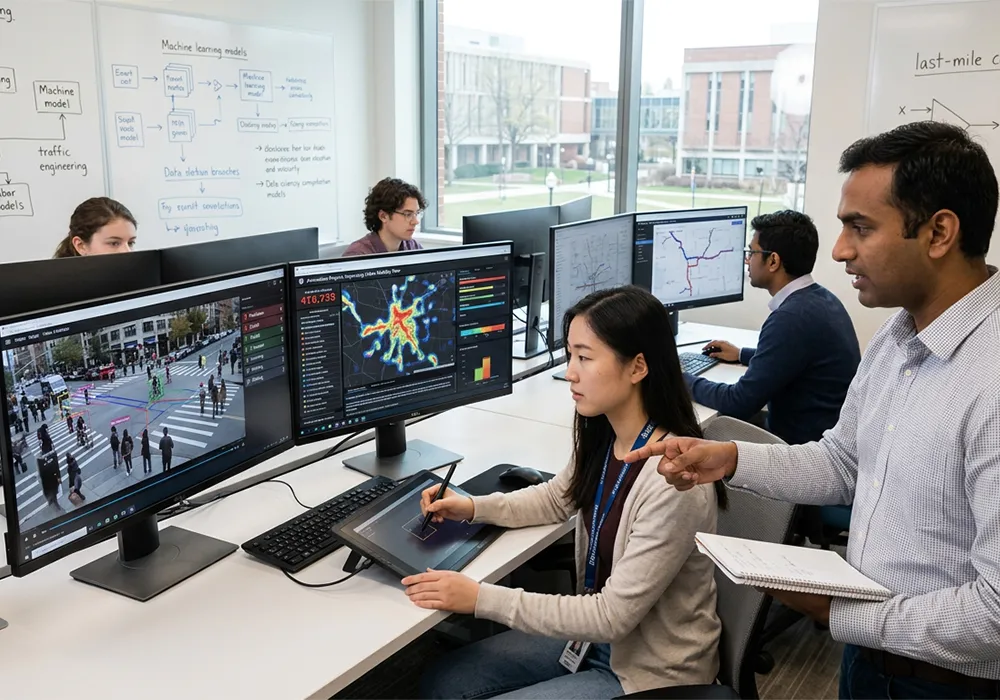
A leading urban mobility research institution was working on advanced AI models to analyze and improve people movement across dense city environments. Their goal was to enhance transportation planning, reduce congestion, and enable smarter infrastructure decisions using computer vision and data analytics.
However, the institution faced a critical bottleneck—lack of high-quality annotated datasets required to train accurate AI models.
That’s where Annotation Support stepped in.
The Challenge
The research institution faced a few challenges:
- Complex Mobility Data
Vast amounts of video and image data collected from traffic surveillance, public transportation, and other pedestrian areas required annotation.
- Multiple Object Categories
Annotation requirements included vehicles, pedestrians, cyclists, traffic signals, road boundaries, and crowd density patterns.
Any errors in annotations affected predictions from their AI models and simulations of mobility.
- Scalability Issues
The university required data annotation for thousands of hours of video, on a stringent timeline.
- Lack of In-house Annotation Expertise
Limited resources for in-house annotation teams were available for high quality annotation.
The Solution
Annotation Support provided them with a customized, end-to-end data annotation solution to suit mobility research.
1. Advanced Annotation Techniques
We employed a combination of:
- Bounding box for cars and people
- Semantic segmentation for road and path investigation
- Polyline annotation for road and lane detection
- Keypoint annotation for human gesture recognition
2. Domain-Specific Training
Our annotators were briefed in:
- Urban mobility patterns
- Traffic behavior analysis
- Pedestrian dynamics
This allowed us to consider contextual information for improved results.
3. Re-scalable Team
We provided a team that was able to:
- Managing large volumes of data
- Reinforcing the team during project crunch time
- Delivering service on time
4. Recursive Quality Assurance
We put in place a 3-tiered QA process:
- First level annotation review
- Quality review by senior annotators
- Final quality audit
5. Tool & Workflow Optimization
We employed latest annotation tools and methods that:
- Reduce turnaround time
- Improve annotation consistency
- Support easy interaction with the research team
Implementation
This project was done in phases:
- Professional Requirements Identification & Data Set Optimization
- Pilot Annotation & Feedback Loop
- Large-scale Annotation
- In-Process Quality Monitoring & Optimization
Annotation guidelines were updated to provide guidance to the model.
Results & Impact
Here were the results of the collaboration:
1. Enhanced Model Performance
- Enhanced object detection and tracking precision
- Better prediction of pedestrian and vehicle movement
2. Better Mobility Knowledge
- Better traffic flow modelling
- Better congestion models
3. Quicker Research Cycles
- More than 40% faster data processing
- Harnessed machine learning model development
4.Real-World Impact
- Facilitated data-informed urban development
- Enhanced safer and smarter transportation systems
Key Benefits for the Research Institution
- High-quality data for AI development
- Annotation support for large projects
- Lower cost of operating a team
- Accelerated research for the mobility space
Conclusion
Through its collaboration with Annotation Support the research institution was able to turn mobility data into a valuable resource. This allowed them to develop strong AI systems that help drive smarter cities, better transport and better people movement.