Author name: admin_asp

agrotech annotations

AI in Agriculture: How Annotated Data Is Feeding Smart Farming?

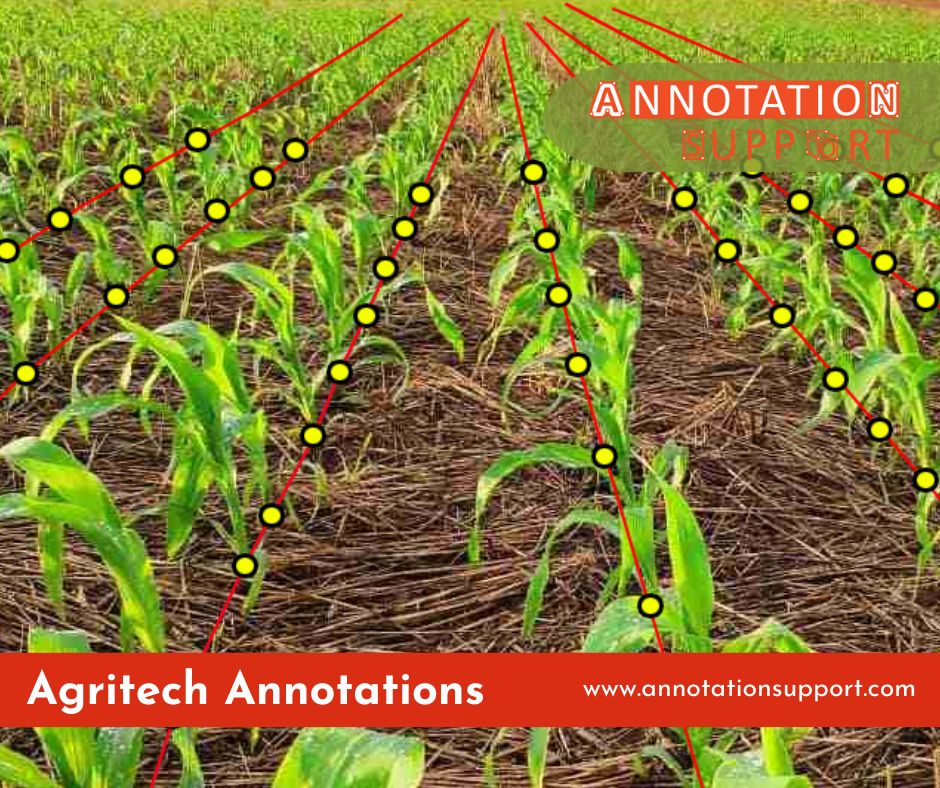
Agricultural industry is going through the digital revolution. Artificial Intelligence (AI) is assisting farmers to make quicker, smarter and more sustainable decisions, whether it is precision irrigation, monitoring crop health, or other purposes. However, in spite of all the mighty AI models in the field of agriculture, there is one key ingredient annotated data. Here we will discuss the power of annotated data to drive AI-enabled agriculture and reasons why it has become the basis of the new agriculture. What Is the Data Annotation in Agriculture? Annotated data: This type of data may be images, videos, or sensor data that has been annotated or tagged to specify particular objects – such as diseased leaves, pest infestations, soil types or crop boundaries. This data in agricultural AI conditions trained machine learning models to identify, distinguish, and infer real-life farm situations with accuracy. Examples include: Why Annotated Data Matters in Smart Farming? The AI systems in agriculture are also no smarter than the information that they are taught. The machine vision systems will not be able to differentiate between the healthy crops and the diseased ones or detect the weeds precisely without proper annotations. This is the way in which annotated data would enhance intelligent farming activities: 1.Precision Crop Monitoring Categorized under drone and satellite photography, AI-powered technology can monitor the state of crops, determine their growth potential, and help in identifying such conditions as nutrient deficiencies or attacks by pests in situ. 2.Automated Weed and Pest Detection With the assistance of annotation services, models are able to detect various weed species or infestations of pests. This allows spraying specifically — lessening the use of chemicals and safeguarding of the soil. 3. Soil and Irrigation Management The annotated soil data (moisture, pH, fertility levels) is used to suggest the irrigation schedule or fertilizers application to the AI to enhance the efficiency of water and resources. 4.Harvest forecasting and Yield forecasting Plant stage labeling is beneficial as AI is capable of predicting the harvest and creating harvest schedules more effectively. 5.Livestock Monitoring Animals Annotated video data is useful in animal farming where it assists in health monitoring, behavioural examination, and even in the early detection of disease in animals. Building Agricultural AI Models: The Role of Data Annotation Services Annotating farm data is a complicated task. It requires: The data annotation providers advertise the accuracy and scalability of agricultural data by collaborating with agritech companies to work on agricultural datasets. The Future: Feeding the World with Data-Driven Agriculture With the growing demand of food in the world, AI powered farming is becoming essential in efficiency, sustainability, and productivity. These innovations are powered by annotated data – transform a raw image or numbers to use. Annotated farm data not only fills the machines with food, but it is also the food of tomorrow to agriculture: agriculture-based AI is being used to predict harvest yields, combat the effects of climate change, among other uses. Key Takeaway: Artificial Intelligence in Agriculture begins with data – and develops when it is properly annotated. The smarter the farm is the better the data is.

Video annotation services
video annotation

How Annotation Support offers Video Annotation Services for Retailers In-Store Analytics?

With the current retailing landscape, which is rich with data, the study of customer behaviour within a store is just as beneficial as knowing the movement in the web environment. Retailers are becoming more and more inclined on using AI-based video analytics to understand consumer way of movement in the store, their interaction, and purchasing behaviour. High-quality video annotation is a background of another important foundation behind any smart retail analytics system. Here very important part is played by Annotation Support, which turns raw surveillance data into datasets, ready to be analysed by AI, which helps retailers to improve inventory management and advance the shopping experience. What Is Video Annotation in Retail Analytics? Video annotation refers to tagging items and actions in in-store video content like people, cart, shelf and movement patterns to use to teach AI models to perform vision on store activity. To retailers it will translate to a gold mine of behavioural and operational data of the answers of CCTV or camera feeds that usually sit on the shelves. How Annotation Support Helps Retailers Unlock Actionable Insights? At Annotation Support, we are developing high quality video labels used in computer vision systems of the retail business. Our professionals of the annotation service and workflows controlled by QA will guarantee that the frames are properly marked, and AI-based frameworks will recognize, follow, and analyse the shopping activity precisely. Here’s how we make it happen 1. Customer Movement Tracking By means of the detection and tracking of objects, we label the routes of shoppers in the aisles to determine which areas are high parameters, their waiting time, and the general physical patterns of movement up and down. Insight: Retailers have the chance of using display racks and shelves to position products to increase prestige.  2. Wait-Time Analysis and Queue Management. We will mark the customer positions at the checkout shelves and the service bays to allow AI systems to generate the average wait and queue length on their own. Insight: Better planning on the staffing and to minimize the wait time to customers during times of fortune. 3. Work Interaction Monitoring. Through activity annotation, we label moments when customers interact with products — picking them up, putting them back, or adding them to carts. Insight: Learn what products people show interest in and to what extent the number of those interested in it translate into buyers. 4. Shelf Stock Monitoring Drawing descriptions of shelves, racks, and areas with products, our video annotation services enhance AI models that identify the state of out of stock items or missing products in real time. Insight: Availability of shelves and simplify the stocking up of inventory.  5. Demographic and Foot fall Analysis. Training AI models that analyse demographic trends are aided by us by annotating attributes like age group, gender, and group size (without the storage of any personal information). Insight: Personalize in-store marketing and increase campaign targeting. Why Choose Annotation Support for Annotation Services? Real Business Impact By partnering with Annotation Support, retailers can: Conclusion Video annotation is re-establishing the concept of the in-store activity to retailers. Video annotation is having a tremendous effect on business with the support services of annotation support on video annotation activities where originally recorded video footage turns into a potent tool of analysis, enabling a retailer to make more intelligent, quicker, and customer-oriented business decisions.

data labelling annotation, human-in-the-loop

Detecting Defects Faster: Annotation Support’s Work with a Global Electronics Manufacturer

In the highly competitive electronics industry, even the smallest defect can have a ripple effect—delays in production, increased costs, and customer dissatisfaction. To stay ahead, manufacturers are increasingly turning to AI-powered quality inspection systems. But these systems can only be as effective as the data that powers them The Challenge Semiconductor manufacturer in the world availed to Annotation Support a very urgent issue: their AI based-quality control system did not render the capacity to precisely recognize defects in their complex circuit boards and device parts. Improperly marked training data decreased the speed of defect detection, created a false positive and wasted time in a production line rework area. The Solution The Annotation support came in with a custom-oriented data annotations plan: Precision on the pixel level – Experts annotated microscopic component images at the pixel level in order to point out cracks, soldering problems, and surface defects. Custom Ontologies – Generated product-range defect categories, so that the AI system was able to learn the difference between serious defects and minor ones. Scalable workforce – Did the same to natively handle thousands of images per day using a hybrid human-in-the-loop and QA-based workflow without losing accuracy. The Results It resulted in transformational: 40% Quickness in the control of any defects – AI models used by the manufacturer detected components with faults more precisely on the move. Less Downtime in Production Caused by Faulty Product – The speed at which faulty units were detected caused less of them to be sent to final assembly. Better Yield and cost Reduction – Typical decrease in the costs of the rework and general improvement in production efficiency. Why It Matters? The given cooperation demonstrates that to reveal the real potential of AI in manufacturing, high-quality annotation is vital. The presence of Annotation Support enabled the client to detect defects faster and more accurately and improve operational efficiency and quality of the products offered to the market thus protecting their stance on the international arena more. We are experts in providing data annotation services, data labeling services for Electronics industry, Interested to get high quality and data secured annotation services, contact us immediately through filling the form at https://www.annotationsupport.com/contactus.php  

autonomous vehicles

How Annotation Support Helped to Improve a Self-Driving Car Model?

Introduction Self-driving vehicles are designs that combine the forces, such as AI models, which are trained to understand the world in the same way that a human does, i.e. recognising roads, cars, pedestrians, traffic signs, etc. in real time. Highly labelled data sets are the main determinant in creating models that can be accurate. Here know how a poorly performing autonomous driving system turned into a safety, more reliable system through professional annotation services of Annotation Support. 1. The Challenge An autonomous vehicle company faced: What ails the fundamental dilemma? Improper and dissimilar data labelling of a previous outsourced company. 2. Project Goals Annotation Support allocated the following techniques: 3. Annotation Techniques Used by Annotation Support Bounding Boxes & Polygons – cars, trucks, buses, pedestrians and cyclists Semantic Segmentation – Pixel Level label of roads, sidewalks, curbs, lanes lines LiDAR 3D Point Cloud Annotation depth / distance – LiDAR labelling Keypoint Annotation – Wheel locations, headlight locations, locations of joints of pedestrians to make predictions of moving direction Occlusion & Truncation Labels -Marking the truncated or occluded objects of the detection training 4. Quality Control Measures 5. Results One quarter-year later, having been re-annotated, and the data set scaled up: 6. Learning Key Points Conclusion Annotation Support does not only deliver labeled data–clean, consistent, context-aware annotations were directly contributed to better results in the AI judgment. In autonomous driving, the quality of the data obtained about perception may mean the difference between a near miss and accidents. With high-quality annotations, the self-driving car model became safer, faster, and more reliable—bringing it one step closer to real-world deployment.

autonomous vehicles, bounding box annotations, polygon annotation

Top Annotation Techniques Used in Autonomous Vehicle Datasets

Autonomous vehicles rely heavily on high-quality annotated data to interpret the world around them. From understanding traffic signs to detecting pedestrians, the success of these vehicles hinges on the precision of data labelling. To train these systems effectively, several annotation techniques are used to handle the wide range of data types collected from cameras, LiDAR, radar, and other sensors. Below are the top annotation techniques commonly used in autonomous vehicle datasets: 1. 2D Bounding Boxes Purpose: To find out and place objects (like vehicles, pedestrians, road signs) in 2D square video. How it Works: In the camera images, box shaped figures encircle objects of interest in the form of rectangles. A label is placed on each box (e.g. car, bicycle, stop sign). Use Cases: 2. 3D Bounding boxes Purpose: To sense the space and the position of the objects in the 3D space. How it Works: In 3D point cloud dataset (typically LiDAR) cuboids are labelled to indicate a 3D object (depth, height, width, and rotation). Use Cases: 3. Semantic Segmentation Purpose: To label each pixel (2D) or point (3D) in a point cloud or image, to a class. How it Works: The pixels of an image are classified based on the object which they are attached to (e.g. road, sidewalk, walking person). Use Cases: 4. Instance Segmentation Purpose: To recognize individual objects and boundaries, even when it comes to objects belonging to the same class. How it Works: Intertwines object detection with a semantic segmentation model to mark every object instance in different manners. Use Cases: 5. Keypoint Annotation Purpose: Indicate certain important locations on items (e.g. at joints of people, corners of traffic signs). How it Works: Keypoints where used are tagged at the important parts of the body such as elbows, knees, wheels of a vehicle or head lamps among others. Use Cases: 6. Lane Annotation Purpose: To precisely identify and mark lanes and lane divisions during the process of driving. How it Works: In detected lanes in images, curves or lines are drawn on top of these lanes. Commonly lines are drawn on top of these lanes via polynomial fitting of curved roads. Use Cases: 7. Cuboid Annotation for Sensor Fusion Purpose: To combine 2D and 3D annotations to improve accuracy through several sensors (camera + LiDAR). How it Works: LiDAR 3D annotations are projected to obtain refinements on 2D camera images with multiple sensor inputs. Use Cases: 8. Polygon Annotation Purpose: To label the objects that have odd shapes and sharp edges. How it Works: The polygons will be a draw around the contours of the objects instead of the bounding boxes, a rectangle. Use Cases: 9. Trajectory Annotation Purpose: To trace the motion-trajectories of dynamic objects between frames. How it Works: The positions of objects are tagged throughout the period to comprehend the velocity, direction and motion in future. Use Cases: Conclusion Proper labelling is the mainframe of the development of autonomous vehicles. All the methods of annotations have their own use, either it is to identify a pedestrian in a crosswalk, or a drivable route in front. With the world moving towards completely autonomous industries, these methods of annotations keep getting more accurate, quicker and scalable with AI-aided tools and with the assistance of human-in-the-loop frameworks. It is not only the training of a car but actually the training of a machine to comprehend the complications of the real world in driving.

Scroll to Top